
Discover the Power of Hugs: Stress Reduction and Emotional Well-being

I’m a hugger. I have always been. Some days I crave a hug. (Is it stress that is motivating me?)
Do you like hugs or do you shy away from them?
I always ask before I hug someone new. My friends know that I’m a hugger. I think sometimes they wait for it. I many times end my notes with a hug, even if it is online. And I mean to send the thought of caring to the recipient.
Have you ever had a very bad day and just want a hug? You know how that feels. Kind of warms your heart and gives you courage to go on.
I do ask when I hug a stranger, but I’ve never been refused! I ask before I hug someone I barely know, but I’ve never been refused. Always, always ask.
Why does it matter that I have to ASK before I hug?
A hug can be an invasion of private space. We are in a society that values space.
Look at a movie theatre. Look at the distances between seating when the theatre is not full. We choose to sit apart. We value space. Now I’m not talking sitting next to chatty people, I’m just making a point. The farther apart we can sit, the happier we are. We like our space.
Do you choose to eat outside when you go to a restaurant? Now I know that the heat of summer or the cold of winter plays into this decision. But have you notice greater commadrie among those outside? Inside the tables are scattered. When we choose to sit inside, it is off to the side by ourselves. I have asked the waitress to move her choice.
Do you clap or sing “Happy Birthday?” This is a group hug for the recipient. Are you part of it?
I know of a friend of my daughter’s who is not a hugger. He really struggles with touch. I asked, he agreed to a hug. Now I think he kind of looks for that hug when we meet. He discovered some advantages of the hug.
What’s the big deal about a Hug?
There is just something about that embrace that says “I care.” I hope when you read it on your note, message, or email, you feel that. I’m sending” “I care!”
Why would I want a hug?

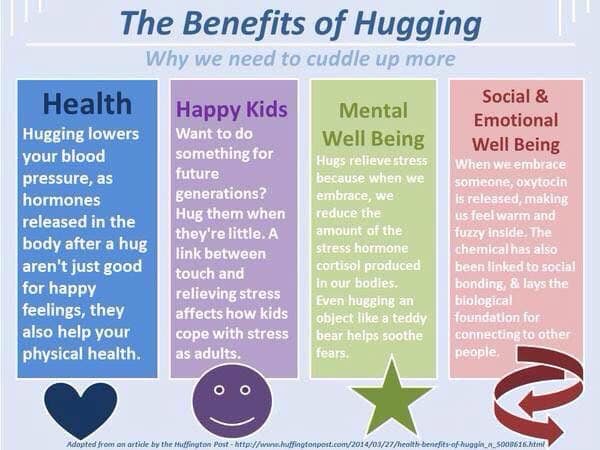
Hugs can have health benefits. We are not always aware of the benefits of it. A Hug can reduce fear, stress, and even pain. It can support your immune system and cardiovascular system with that embrace.
A hug activates the part of your brain, your parasympathetic system (vagus). This system restores energy and repairs our body. It also elevates feelings of love, compassion, and gratitude.
A hug can release the “love hormone,” Oxytocin. When you are embraced you can feel trust and attachment, even just for the moment. Ocytocin helps ease this bonding by activating the pleasure parts of your brain. This hormone is also related to happiness. This hormone is what generates “that feeling.”
There is something special about oxytocin and mothers. Women feel this effect when they cuddle their babies closely. It can literally make a mother’s heart “sing and feel warm!”
WHAT HAPPENS WHEN YOU DON’T GET HUGS?
Not receiving physical affection can be related to loneliness, depression, and stress. It can also cause physical pain and poor sleep quality. Additionally, it could result in personality disorders and attachment issues. No physical affection can also lead to trouble in “feeling” emotions in general.

That’s how important a Hug is.
What does a hug really do for my body?
Bedtime Hugs: definitely will help your brain calm down and sleep better. Feeling secure in a relationship does help you sleep calmly.
A bedtime hug for a child can be quite powerful. It sends them to sleep with the feelings of “I’m loved” and “I’m cared for.” Powerful.
Hugging a newborn child can increase the baby’s weight and improve all-over development. For a child to develop with good self-esteem, they need hugs frequently. Children need hugs more so than an adult, who already has a sense of self-esteem.
A hug from a loved one decreases cortisol, the stress hormone. Touch will disable the part of the brain that reacts to stress, and leads to a more relaxed rest.
Well-being Hugs: touch biologically reinforces the part of the brain that gives you calmness.
Serotonin is also released with a hug. This hormone elevates mood, controls anxiety, and reduces feelings of aloneness.
Hugs improve Immunity: It is understood that hugs give us perceived social support. This can lead to being sick less. The feelings of belonging is one of the tenets for good health.
The gentle pressure on your sternum with a good hug stimulates the thymus gland. This gland regulates and balances your body’s production of white blood cells. These are the cells that keep you healthier.
Studies relate to improved immunity from the reduction of the feelings of stress/tension/conflict. Non-sexual hugging is a means of conveying empathy, caring, and reassurance. Powerful feelings.
It is interesting to read that more hugs can increase salivary oxytocin. They can also lower levels of alpha amylase (3) and lower blood pressure.

The 10 second hug is actually better than the 1 second or quick hug. The longer hug goes farther.
Time does make a difference in a hug: 10-second helps the body fight infections, eases depression, and lessens tiredness. A 20-second hug reduces the harmful effects of stress. It can lower cortisol. It also relieves elevating blood pressure, and can actually help your heart.
The release of the hormone, dopamine, is what gives us that “good feeling.”
Hugs help your heart and cardiovascular system. A good hug can actually lower your blood pressure. This effect lasts even after the participant has left the room.
Interpersonal touch is linked to increased attachment security. A hug, or at the least, a pat on the shoulder, is linked to support. Touch gives higher relationship satisfaction, and eases conflict.
We know that a good hug will help with physical pain. Just the touch of knowing someone cares can make a difference. Cancer patients who received hugs of a healing-touch report less post-operative pain. A hug can also help with less use of narcotic painkillers. Amazing.
A hug can actually influence physical performance. A study with the NBA showed that teams with higher touch rates, actually performed better. That tap on the shoulder, head-bump, chest-bump (depending on sport) seems to transfer a lot of trust. This trust enhances their performance.
Childhood teams need to encourage “team-ship.” My thought is that no child should sit by themselves on the bench. A team needs to be together, even on the bench. They don’t have to touch at a young age. Just knowing someone is next to you is a big start. At a time-out, or half-time, team members need to finish with a hand-hold pat.
When someone feels a part of the bigger picture, losses are not so personal. It is not the individual that lost, it is the team. Touch eliminates that overwhelming emotion that many times leads to tears. This is also the time for the hug or the pat on the shoulder that says: I’m here. I’m proud of YOU.
Start early and your child will never feel alone.
Hugs can reduce Fighting: Couples who hug more, fight less. It is thought that a good hug blunts negative feelings. It also reduces the stress of the day.
Cortisol is a killer when left unchecked. Stress is part of our daily routines. Those who received hugs often believed they had better social support, and helped lower the stress hormone.
Snuggling with your pet works great to release your “cuddle” hormone, oxytocin. Not only does it build an attachment, but it also releases those “feel good feelings.”
A hug, according to a study, a hug can reduce the anxiety of mortality. It makes us feel safe. It makes us feel not so alone. This thought is fascinating. No one wants to die alone. Those hugs give us courage to face the unknown.

GIVE YOURSELF A HUG!
Don’t be afraid to hug yourself! Sounds silly. But putting your arms around yourself can reduce your pain. The thought is that that self-physical touch is not what your body expects. This confuses the brain as it tries to figure out where the sensation is coming from. Pain is blocked by crossing your arms.
“You play the most important role in your own wellness, and hugging yourself can help remind yourself of your power. Instead of waiting for someone to hug you and offer support, make yourself feel better and give yourself that hug. (2)
Research says: 4 a day for survival; 8 hugs a day for maintenance; and 12 hugs a day for growth. That sounds like a LOT! But when I think of a child and hugs, it makes sense to me.
Start with that morning self-hug. I think it is more powerful than the suggestion of making your bed each morning. It has been said that that making your bed gives your brain organization to start the day. You have accomplished a task. The day is not wasted. Imagine what that self-hug will do too!
That morning self-hug would go even farther. It gives you power. It gives you self-confidence. Try it! You’ll be surprised.
It is unfortunate that most people in the USA are touch-deprived. We don’t like to be touched, or we think we don’t like it. We live solitary and busy lives. This reduces social interactions, and …touch. How many people are living by themselves? Or perhaps living with people that they don’t really interact with due to schedules. This definitely breeds loneliness. Start with the Self-Hug.
ALWAYS ASK:
Our society pushes people from touch who are not directly related to them. This social norm is putting our society at a great disadvantage. We are becoming distant to our neighbors. Maybe more hugs would mean less anger. (I do strongly suggest: always, always, ASK if you can give a hug. Then it won’t be misunderstood.)
Did you stand in front of a check-out person, in a store, who obviously is having a very bad day? It can be hard to deal with the public sometimes. I ask if they want a hug? And the answer is always “yes.” I also tell them during that moment that I value their work. It is a moment of gratification for both of us. Priceless.
Notice the differences in touch among other countries:
Look at other countries. The live as communes, meaning that grandparents or siblings live together more often than solitary. Family is the support. Elders babysit. Cousins interplay with the babies. Family gatherings is a part of life. Touch is every day. They are happy with the support.
In the USA, we are content with sometimes only holiday gatherings. Why? It is much more gratifying to gather when the only talk may be who wants to play what? That’s when touch becomes deep.
The importance of human connection cannot be stressed enough. We need it.
When someone wraps their arms around you, you do feel the comfort and a feeling of not being all alone. It warms our soul.
It is no surprise that a good long hug can make us feel so good.
I’ll be sending you a hug each time we communicate! Who says a non-verbal hug doesn’t count?
Reference:
2. https://www.healthline.com/health/hugging-benefits
3. https://www.healthline.com/health/hugging-benefits
3.)The ability of alpha amylase to hydrolyze (break down) starch primarily benefits the digestive system. Additional health benefits of alpha amylase include support for the immune system. It aids in the management of inflammatory conditions. It also provides support for aging. (https://www.xtend-life.com/blogs/supplement-ingredients/amylase#)
4. NIH: Does Hugging provide stress-buffering social support? https://www.ncbi.nlm.nih.gov/pmc/articles/PMC4323947/
5. https://www.medicinenet.com/how_do_hugs_make_you_feel/article.htm
 Mary Jessen: Wellness Makes Cents