Enjoying the good things in life!

Posts tagged ‘#cocoa’

How Chocolate Is Made: A Cacao Journey from tree to Valentine!

There is something special about seeing how chocolate is grown. I never imagined it growing on a tree! How did you image cocoa in it’s natural form?

I did not imagine cocoa starting in a pod on a tree. I did not know of the health benefits of dark chocolate. Nor did I imagine it growing in a tropical forest?

On our vacation this past Fall, my husband and I saw how chocolate candy is made. We visited a home in Mexico where cocao was made into chocolate.

I was not aware of all that is involved in creating a piece of chocolate candy. I also did not know what is involved in making a packet of hot cocoa. But we sure did want to see how it was grown.

Wait: isn’t it cocoa?

First let me say it is a Cocao plant, or Cocao Tree.

What is the difference between cocoa and cacao?

The tree, pod, and bean/seed are typically referred to as “cacao.” The word “cocoa” is used to call the bean once it has been fermented, dried, and roasted.

How it all begins:

Chocolate begins with growing on the “cacao tree” (Theobroma cacao). It grows within 20° north and south of the Equator. It thrives on a mix of hot temperatures, a good amount of rain, and oddly also shade.

Cocao is grown in protective pods that form directly on the tree or branch.
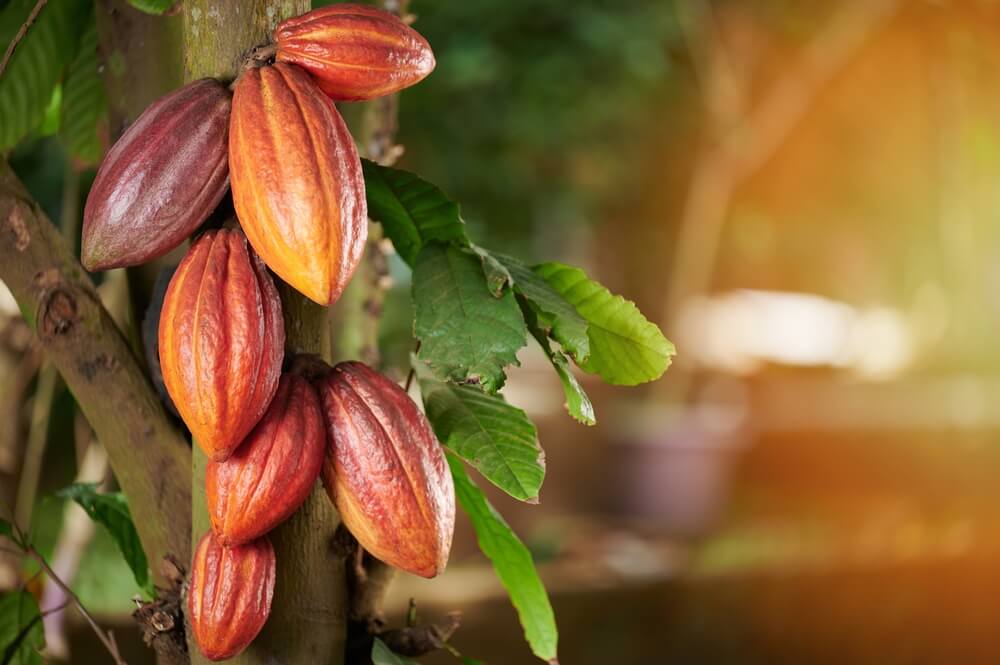
Each tree bears many pods, which are about 5–12 inches long. Each pod contains 30–50 seeds, and it’s these seeds/beans the world knows as cacao (or cocoa) beans.

(Technically what is inside the pod is a seed for the next generation.)

Cacao pods are ripe when they turn a vibrant yellow/orange color. (The pods we saw were yellow, more of pear-yellow.)

The ripening pods hang from the trunk and on the larger branches. The pods hang by small stems. They are typically harvested twice per year. However, they can be harvested continually as flowers and pods can happen at the same time.

Cocao trees grow along-side banana and other fruit trees. These other trees provide some shade and a buffer of rain water for the cocao tree. (Cocao trees need lots of rain, but evidently not direct.)

It is typical to find a Cocao tree in someone’s yard.

Harvesting:

Harvesting is done by hand with a long handled knife. Care is taken not to damage the tree or the pod when harvested.

The pod can easily be opened. Sometimes it opens by just cracking the pods together.

Another method is hitting it with a mallet or knife. (I was amazed to see a gal just knock the pods together and they opened!)

The pod opens up to a milky center where there is a “cone-like” structure that houses the chocolate beans. The beans are covered with a milky substance that is really quite sweet to eat. Bob and I did try this substance. We enjoyed the sweetness. It was kind of a cross between a kiwi and a pineapple, with just a very minor hit of cocoa.

In Latin America, this pulp is called baba. It was used to make a fermented cacao wine as early as 3,000 years ago.

Cleaning and washing:
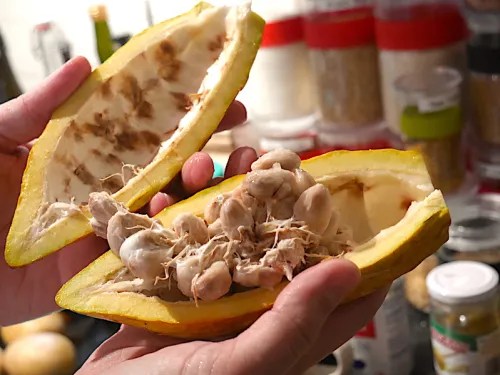
Beans are cleaned by hand, with the baba (pulp) left on to help develop flavor. Exposed to light, the cream-colored beans turn a purplish color.

The milky substance is washed off the beans, after which the beans are put out to dry. Drying is important.
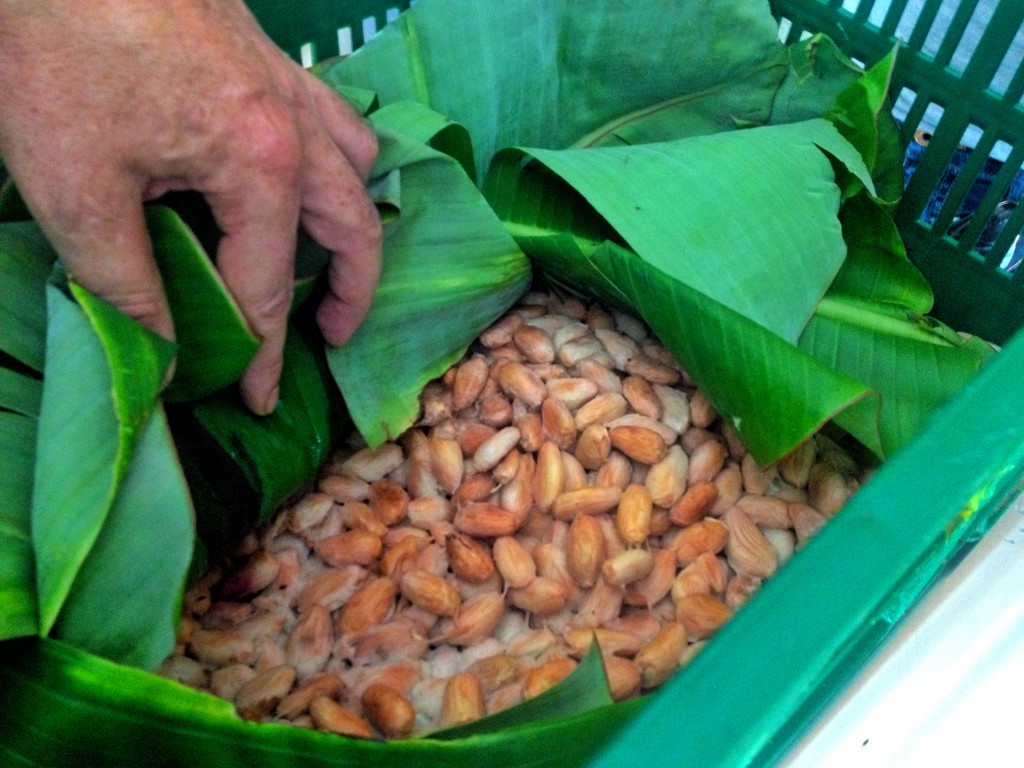
In Latin America, cocao beans are covered with banana leaves. The beans are layered in special boxes that allow ventilation.

The fermentation process lasts between 2-9 days. During this time, the beans begin to take on the dark purple color. They also develop some flavors you would recognize as “chocolate.”

The beans need to be stirred often so that all of them can be dry uniformly.

Notice they are dried in the shade. Outdoors is too much sun.

Market time:

The beans are separated as they dry. Once dried, the beans are graded, packed into sacks, bundled, and checked for quality. They are then shipped and traded on the international market.

Or, in the case of direct trade (for craft, bean-to-bar chocolates), the beans are exported directly to the chocolate maker.

Several chocolate companies source cocao beans directly from farms, including Ferrero, Lindt & Sprüngli, Askinosie, and El Rey. They then process their own way for their distinct flavors.

Processing cocao:

At home, great care is taken with the drying process. The beans must dry on a ventilated platform, out of the sun, and stirred often.
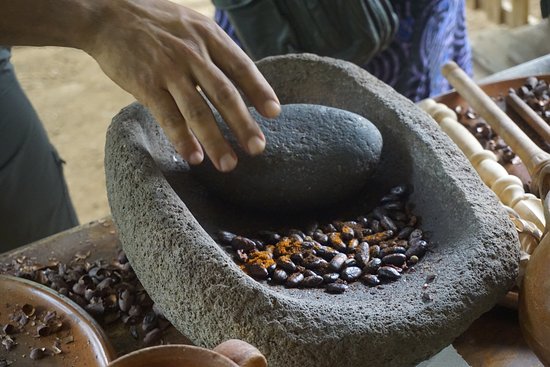
When the cocao is processed at home, after drying, the beans are rolled with a wooden pin or stone. They are crushed into a fine dust. Sugar and Cinnamon is add to this process. This home process is a lot like the manufacturing “conching” which is done by machines.

When the cocao becomes cocoa powder:

The cocao bean has become cocoa powder. With more grinding, the powder changes some more.

Crushing continues until the substance becomes almost paste-like. This is the first chocolate candy. The paste can be rolled together into a ball. And then flattened to make a slab of chocolate!

Sometimes it is just cut and packaged. After all the work: Candy is made!

But this chocolate is oh so good and different from what I would buy in the store. It is not overly sweet. It most definitely tastes of chocolate.

The chocolate that Bob and I tasted was more the raw chocolate candy. Just cocoa beans, sugar and cinnamon. (Butter may develop from all the rolling. Rolling creates a heat that slowly blends the ingredients together.)

The chocolate we can purchase in a store in the USA is much different. It is unlike the natural chocolate found in a Mexican home.

Processing at home:
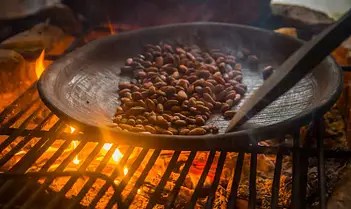
When creating chocolate at home, the beans are still need to be cleaned. They are soaked and stirred and stirred to dry. They are tended carefully.

Then the beans are roasted at low temperatures to develop flavor.

(Illustrated is an at home roasting. )

Shells are separated from the roasted beans (the “meat” of the bean) by a process called winnowing. This is where the chocolate nib is formed.

Nibs are the finely ground cocoa beans. These nibs are ground into a cocoa mass. At room temperature the grinding can result in a solid paste. (Placed under extremely high pressure, this paste yields two products: cocoa powder and cocoa butter.)

The grinding process transforms the cocao bean into cocoa powder. This can be done by hand or machine. Once ground, it is ready to add any flavorings desired.

Cocoa butter happens through more grinding, then pressing out the liquids to separate the cocoa butter from the solids. 

The chocolate we buy in the store:

The chocolate production process consists of fermentation, drying, and roasting and grinding.

Mixing of all ingredients, after grinding, is next. (This is the cocoa mass, sugar, cocoa butter, emulsifiers, aroma, and milk components if needed. This is where the individual chocolate companies develop their own flavors.)

Conching (rolling) and tempering complete manufacturing process.

Conching is a vital step in chocolate making that involves mixing, kneading, and grinding chocolate to achieve a smooth and consistent texture. Conching is usually done by machine. The chocolate becomes a very smooth paste.

In Mexican homes, conching is done by hand to create the desired powder. Homemakers add flavorings, such as sugar and cinnamon at this point.

Major chemical reactions occur during fermentation, drying, roasting of cocoa beans, and conching of the chocolate mass. These reactions are the most important for flavor and aroma development. For candy companies this process is done mechanically and under great control.

Once received by the processor, beans may be blended with other ingredients. This creates desired characteristics. Alternatively, they can be kept separate as “single-origin chocolate”.

White chocolate is made with cocoa butter, sugar, and milk powder (but no cocoa mass/liquor). Because it contains no cocoa mass, some do not consider it a true chocolate.

A top ranking superfood!

“Dark chocolate: what was once considered a sweet treat, is now considered one of the top-ranking superfoods.

Chocolate dates back to 2000 BC when the first chocolate connoisseurs drank it as a beverage. Long after, chocolate was revolutionized with the invention of chocolate bars in the 1800s.

Why is dark chocolate healthy?

Chocolate is widely consumed by all generations. It is rich in fat, proteins, carbohydrates, polyphenols and other bioactive compounds [1].

According to hsph.harvard.edu, dark chocolate contains high amounts of flavanols.

Flavanols, which are plant chemicals derived from the cocoa beans, have been linked to protecting the heart from cardiovascular diseases.

Additionally, cocoa is also rich in iron, magnesium, phosphorus, copper and zinc.

It’s no wonder numerous doctors urge individuals to make dark chocolate a part of their everyday diet and nutrition.”

Impressions from our trip to see cocoa produced:

It was most interesting to see how easy cocoa can be “made.” I guess I had no idea where the powder originated. We were surprised at the casual production that happens in a home. Chocolate is sold on the street. It is not governed by the government. It is just a local produce.

Mexico opened my eyes to natural foods. Cocoa was just the beginning for me.

Truly a healthy gift!

Chocolate has become the candy of choice for Valentine’s Day. We associate it with love.

And to Montezuma’s credit, scientists say that chocolate contains two chemicals. These are Phenylethylamine and Serotonin. They are associated with heightening romantic urges, happiness, and overall energy. They also increase blood pressure and sugar levels which is a similar reaction to those in love.

Why do we love it so? Why do we crave it at times?
It is the chemical Phenylethylamine (PEA), which triggers the brain’s pleasure centers and induces feelings of happiness and excitement. This chemical reaction is similar to the feeling of falling in love, making chocolate an emotionally rewarding experience.

We fell in more in love with chocolate after visiting Mexico by watching cocao being harvested and chocolate candy being made.

Dark chocolate is recommended as a healthy natural treat.

When you buy the box of chocolate, select good quality, and try to add some dark chocolate. Dark chocolate is greater in nutrients than milk chocolate.

By choosing your chocolate gift wisely, you know that you are giving your sweetheart a healthy heart treat!

Happy Valentine’s Day!

https://wellness.maryjessen.com

References:

https://www.lakechamplainchocolates.com/making-chocolate/

https://www.popcornforthepeople.com/blogs/blog/dark-chocolate-health-benefits

Delicious Homemade Hot Chocolate Recipe and the history of the cocoa bean

Homemade Hot Chocolate in a sweet mug: “You sweet, creamy heavenly thing! I want to spend every winter evening curled up with you. I want my hands are wrapped around a warm mug of hot chocolate. I will watch steam rise from the cup. The whipped cream on top slowly softens. It melts into the creamy dark brown liquid. Slowly my body starts to melt into that cup. I feel the tension ease away.”

What a great tension/stress reliever! I always try to have some “idea” in the back of my head for a secret tension tamer. Hot cocoa hits the spot!

The joys of a cup of Hot Cocoa.

Hot Cocoa for ONE:

2 tsp of cocoa powder, 2 Tbsp of sugar. Heat 1 1/4 cup of milk until warm/hot. Pour a little of the hot milk just enough to cover the powdered mixture. Dissolve the cocoa and sugar with a spoon or small whisk. Once you have a “chocolatey” base, add 1/4 tsp of vanilla. Pour the rest of the milk into the cup, stir and Enjoy!

I want to know more about this wonderful flavor! Where did the cocoa come from? How did it get from field into my cup?

Origins of the cocoa bean:

The cocoa bean is really a fermented seed of the Theobroma cacao, the cacao tree. From the fermented seed, cocoa solids (nonfat substances) and cocoa butter, (a fat substance) are extracted.

Today the cacao tree grows in a limited area of West Africa, and Indonesia. West Africa produces 81% of the world’s crop. There are three varieties: Forastero, Trinitario and Criollo (in order as pictured); Foraster is the most widely used variety.

What it takes to produce one pound of chocolate:

The cocoa tree takes five years of growth to produce it’s fruit, the cocoa pod. The tree has a typical lifespan of 100 years!

To produce 1 pound of cocoa, you need about 400 dried cocoa beans. A typical cocoa pod contains 30-40 beans. Cocoa pods weigh about 14 oz each. The yield is about 9-10% of the total weight. One person can separate the beans from about 2000 pods per day.

The beans are roasted, cracked, and de-shelled, resulting in what is called nibs. These nibs are then ground into a thick paste known as chocolate liquor or cocoa paste.

A cocoa pod, picked by hand, is 6.7-7.9 inches long. It varies in colors: green, red, or purple as they mature. Once mature their color is yellow or orange, particularly in the creases of the pods.

These pods grow directly from the trunk of the tree or a large branch. The pods do not ripen at the same time, so harvesting needs to be done periodically throughout the year. Ripeness is a judgment of color of the pod. They are harvested with a curved knife or a long pole.

Cocoa pods have to be harvested carefully to avoid damaging the junction where the stem is attached to the tree. This is where future flowers and pods will emerge. (It seems to be quite labor intensive.)

It gets better! The harvested pods are opened with Machetes! to expose the bean.

Oh my!

The pulp and bean are harvested, and the rind is discarded. This is an essential process in which the beans are laid out in bins or grates. They “sweat” as the thick pulp liquifies during fermentation. If sweating is interrupted, the resulting cocoa will be ruined. If underdone, the seed’s flavor is like a raw potato and becomes susceptible to mildew. Some cocoa countries distill alcoholic spirits with the liquefied pulp. (Think Aztecs with their potent cocoa drink.)

Processing:

Cocoa butter and Cocoa powder are separated using a hydraulic press or the “Broma process.”

Natural cocoa utilizes the Broma process. This involves hanging bags of roasted cocoa beans in a very warm room, above the melting point of cocoa butter. This allows the butter to drip off the beans. It is then collected. Natural cocoa powder produced with the Broma process retains the natural pH level.

Once the cocoa butter has dripped off, the beans are put out to dry.

Treating cocoa with an alkali produces Dutch process cocoa. Dutch processed cocoa, called Dutch cocoa, or alkalized cocoa, is cocoa solids that have been treated with an alkalizing agent. This treatment reduces the natural acidity of cocoa. It gives it a less bitter taste and a darker color compared to “natural cocoa” extracted with the Broma process. It forms the basis for much of modern chocolate, and is used in ice cream, hot chocolate, and baking.

To all the bakers reading this:

(Illustrated is the difference in color due to the processing. Dutch cocoa is on the left, and natural cocoa is on the right.)

For you bakers to know: Dutch processed cocoa has a neutral pH. It is not acidic like natural cocoa. In recipes using sodium bicarbonate (baking soda), the cocoa’s acidity is necessary to activate the leavening agent. An acid must be added to the recipe. One can add cream of tartar or use buttermilk instead of fresh milk.

There is no need to add acidity when using baking powder in recipes with Dutch processed cocoa. Baking soda is not used for leavening in these recipes.

Dutching greatly reduces the levels of certain phytochemicals in cocoa.

Phytochemicals:

(Medium close up image of David Kebu Jnr holding cocoa beans drying in the sun.)

Phytochemicals are chemicals from plants that may affect health, but are not essential nutrients.

The flavonol-rich chocolate and cocoa products may have a small blood pressure lowering effect. The beans also contain theobromine, and a small amount of caffeine.

Hot cocoa has nutrients!

“It is the ‘theobromine of the cocoa seed that has the affect on blood pressure. Theobromine is an alkaloid. It naturally lowers blood pressure. This, in turn, decreases the risk of cardiovascular disease. There’s also some evidence theobromine may reduce “bad” cholesterol and improve “good” cholesterol. Additionally, the substance may improve blood flow throughout the body, further supporting the heart.” (tcho.com/blog)

Theobromine can also stimulate similarly to a cannabis high, but at a much lower level. It thereby produces a relaxing effect and relieves stress. (I knew there was a reason to feel so good after a cup of hot cocoa!)

Pharmacology: “theobromine is also used as a vasodilator, a diuretic, and heart stimulant. And similar to caffeine, it may also be useful in management of fatigue.”1

Caffeine in cocoa

Theobromine is also present in small amount in tea and coffee.

Caffeine is highly water soluble, peaks in the blood 30–40 minutes after ingestion, and has a half-life of 2.5–5 hours.

Theobromine is fat soluble. It attains peak blood concentrations 2–3 hours after ingestion. It has an estimated half-life of 7 –12 hours.

Some people are able to drink hot cocoa before bedtime with no sleep issues. I suggest you try it first on a night where sleep may be important.

Caffeine in cocoa:

Dutch cocoa contains 3 times less caffeine:

  • 100 grams unsweetened cocoa powder processed with alkali contains 78 mg. (Dutch proccessed cocoa)
  • 100 grams unsweetened cocoa powder without alkali contains 230 mg. (natural cocoa with Broma process)
Cocoa has some nutrients in the bean! Coffee not so much.

Cocoa on the international market.

There are international and national initiatives to support cocoa production. Many nations working together for a common good.

These international and national initiatives aim to support sustainable cocoa production. This group of initiatives includes the International Cocoa Organization (ICCO), Swiss Platform for Sustainable Cocoa (SWISSCO). It also includes the German initiative on Sustainable Cocoa (GISCO), and Belgium’s Beyond Chocolate. Countries where chocolate is significant.

These initiatives gather to support sustainability of cocoa production. Protection of the environment. Deforestation. Sustainability of Cocoa trees. A watch of pesticides and fungicides on exports/imports. And many more environmental themes.

One of the biggest problems in the cocoa industry is the use of child labor. This is a significant problem in West Africa. With the work of the partnering governments, child labor is decreasing. (The US is also involved in this issue.)2

Cocoa is a big contributor to many West African economies.

Since 2008, the demand for cocoa has risen steadily at over 3% annually.

In 2020, world production of cocoa beans was 5.8 million tonnes, led by Ivory Coast with 38% of the total. Secondary producers were Ghana and Indonesia (each with about 14%).

We all love cocoa! Not only is it sweet to drink, but it’s also healthy!

The Difference Between Hot Chocolate and Hot Cocoa

There’s nothing like a mug of hot chocolate topped with whipped cream or plump marshmallows on a winter day. Or wait, of should it be hot cocoa? Aren’t they the same thing?

What is the difference other than color? Is there a difference in taste?

(illustration on the differences: note the different colors.)

Are Hot Chocolate and Hot Cocoa the Same Thing?

While both names are attached to a delicious, “chocolaty” beverage, hot chocolate and hot cocoa are, in fact, different. 

Hot cocoa is made from cocoa powder, sugar, and milk. It’s sweet thanks to the sugar and is light in texture. 

On the other hand, hot chocolate is finely chopped chocolate mixed with hot milk. It’s super-rich and thick in consistency compared to hot cocoa, which is a bit thinner. (the sweet is in the chopped chocolate bits). And no it’s not the same as “hot chocolate milk”- which is warming up cold chocolate milk. Also delicious!

Healthy Hot Chocolate Ingredient Swaps

Although it is a treat, you can make it healthier without sacrificing taste.

Sugar
Swap the sugar for ¼ cup of honey, maple syrup, or ½ cup of coconut palm sugar.

Dairy-free milk
Swap the regular milk with your favorite milk alternative to make this dairy-free. I’ve tried this recipe with oat, soy, rice, and almond milk, and it always turns out great.

Dutch Process vs. Unsweetened Cocoa Powder

Hot cocoa made with unsweetened cocoa powder will have a richer flavor. Dutch processed tastes flatter. It usually needs to be offset with more sugar and full-fat milk.

It all depends on your taste. Sweet and creamy, or rich and thicker?

Needless, to say, whilst the two are subtly different, one thing remains the same. They both taste wonderful.

Time to make a cup of Hot Cocoa!

Recipes Please!!

Homemade Hot Chocolate for one:

Place 1 cups of milk, 1 Tbsp of unsweetened cocoa powder, 1 Tbsp. granulated sugar, 2 Tbsp of chocolate chips, and last: 1-2 DROPS of pure vanilla extract. Heat milk, cocoa powder, and sugar in a small sauce pan. Heat on med/low heat, whisking frequently, until warm. (but not boiling!) Add chocolate chips and whisk constantly until chips are melted. Distribute evenly into the milk. Whisk in the pure vanilla extract, and Enjoy!

Adding vanilla at the very end, gives a nice vanilla flavor to the cup.3

Healthy Protein Hot Chocolate:

If you are craving chocolate and want more than just a warm cup of milk, try adding protein powder. I suggest Shaklee’s Life Shake, addition to your mix. You can easily make that “time-out” time for a meal!

I am torn between Rich Chocolate Life Shake, Cafe Latte Life Shake and the New Salted Caramel Life Shake. Shaklee offers Soy, Dairy-free, Vegan, Gluten-free, and Kosher in many flavors.

Their flavors are smooth and rich. The new Salted Caramel Life Shake can be combined with the Rich Chocolate flavor. You are getting a lot of nutrition, including protein, in a warm, soothing, cup of steamy hot cocoa.

(A purchase of Salted Caramel Life Shake this Fall sends a $5 donation to Baby2Baby, an organization that provides basic essentials to children living in poverty across the US.)

All shakes include 20 g Ultra-pure, non-GMO protein. They have precise ratios of all 9 essential amino acids. This supports energy and satiety. 24 Essential vitamins and minerals to support heart, brain, immune, and overall health. 6 g Dietary fiber and a proprietary prebiotic from an ancient grains blend to support digestive health and regularity. Our new, low-glycemic sweetener system, Reb M + 5 g natural sugar cane. The new Life Shake is Powered by Leucine® to help build lean muscle, burn fat, and support metabolism.†

Plant based proteins are made with Pea Protein, L-leucine, Organic Chia Seed Protein, and Organic Pumpkin Seed Protein. They include pea protein, organic chia seed protein, and organic pumpkin seed protein. Pea protein, chia seeds, and pumpkin seeds are excellent sources of protein and fiber. They provide essential nutrients that support overall health and wellness.

Hot cocoa additives to give your cup a unique taste:

Hot cocoa can be the base for many different flavors. You can choose a different extract, but be certain it is a pure and not imitation. Adding your extract last will enhance the extract’s flavor.

Add spices! (Cinnamon and a pinch of cayenne pepper will turn your cocoa into Mexican Hot Cocoa!) Don’t be afraid of Pumpkin pie spices.

Mix in nutella for a hazelnut flavor. Swirl caramel into the milk.

You can make your hot cocoa with a strawberry base: Puree fresh strawberries first and add to the milk. Oh! Chocoalate and strawberries!

Add a splash of bourbon, whiskey or a liqueur, or Bailey’s for an adult after-dinner drink!

To be extra fancy: rim your cup with chocolate syrup, caramel syrup of another other sticky sweet syrup. Coat the stickiness with crushed peppermint candies, cookies or even toasted coconut. Add a bit of sprinkles for color!

Don’t forget to share!

Cocoa is good for All Ages! (Just be careful of the temperature.)

My favorite cup of hot cocoa is to top with real Whipped Cream!

Sit down, sit back.

Take a mini-time out and Enjoy!

References

https://wellness.maryjessen.com

References:

  1. https://tcho.com/blogs/news/8-health-benefits-of-the-theobromine-found-in-chocolate# ↩︎
  2. https://en.wikipedia.org/wiki/Cocoa_bean ↩︎
  3. https://www.laurafuentes.com/how-to-make-homemade-hot-cocoa/ ↩︎

https://en.wikipedia.org/wiki/Dutch_process_cocoa

https://www.britannica.com/topic/cocoa-food

https://pmc.ncbi.nlm.nih.gov/articles/PMC3672386