
How Chocolate Is Made: A Cacao Journey from tree to Valentine!
There is something special about seeing how chocolate is grown. I never imagined it growing on a tree! How did you image cocoa in it’s natural form?
I did not imagine cocoa starting in a pod on a tree. I did not know of the health benefits of dark chocolate. Nor did I imagine it growing in a tropical forest?
On our vacation this past Fall, my husband and I saw how chocolate candy is made. We visited a home in Mexico where cocao was made into chocolate.
I was not aware of all that is involved in creating a piece of chocolate candy. I also did not know what is involved in making a packet of hot cocoa. But we sure did want to see how it was grown.
Wait: isn’t it cocoa?
First let me say it is a Cocao plant, or Cocao Tree.
What is the difference between cocoa and cacao?
The tree, pod, and bean/seed are typically referred to as “cacao.” The word “cocoa” is used to call the bean once it has been fermented, dried, and roasted.
How it all begins:
Chocolate begins with growing on the “cacao tree” (Theobroma cacao). It grows within 20° north and south of the Equator. It thrives on a mix of hot temperatures, a good amount of rain, and oddly also shade.
Cocao is grown in protective pods that form directly on the tree or branch.
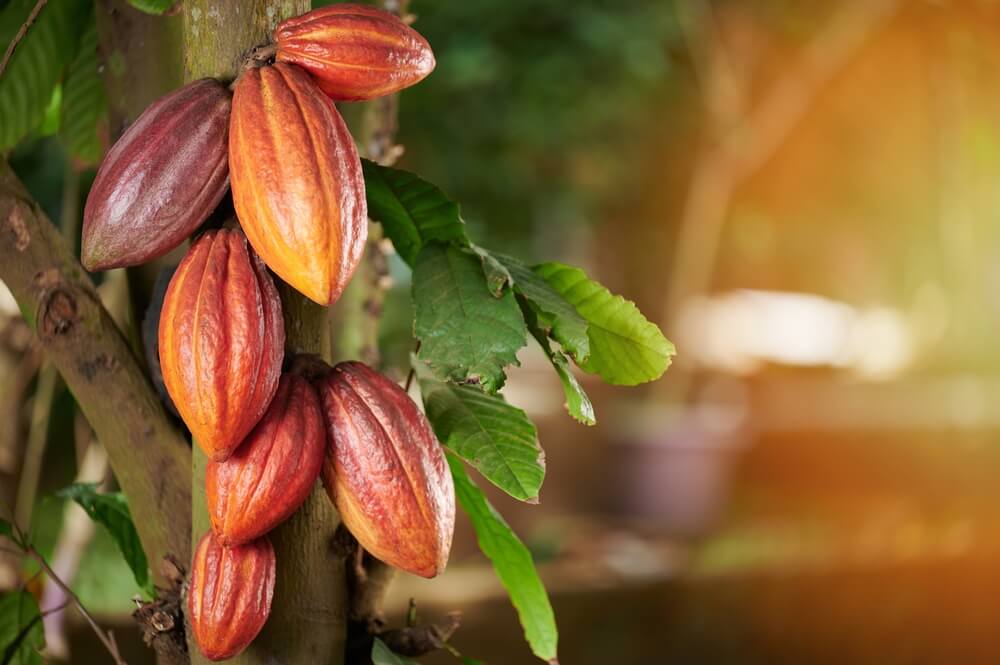
Each tree bears many pods, which are about 5–12 inches long. Each pod contains 30–50 seeds, and it’s these seeds/beans the world knows as cacao (or cocoa) beans.
(Technically what is inside the pod is a seed for the next generation.)
Cacao pods are ripe when they turn a vibrant yellow/orange color. (The pods we saw were yellow, more of pear-yellow.)
The ripening pods hang from the trunk and on the larger branches. The pods hang by small stems. They are typically harvested twice per year. However, they can be harvested continually as flowers and pods can happen at the same time.
Cocao trees grow along-side banana and other fruit trees. These other trees provide some shade and a buffer of rain water for the cocao tree. (Cocao trees need lots of rain, but evidently not direct.)
It is typical to find a Cocao tree in someone’s yard.
Harvesting:

Harvesting is done by hand with a long handled knife. Care is taken not to damage the tree or the pod when harvested.
The pod can easily be opened. Sometimes it opens by just cracking the pods together.
Another method is hitting it with a mallet or knife. (I was amazed to see a gal just knock the pods together and they opened!)
The pod opens up to a milky center where there is a “cone-like” structure that houses the chocolate beans. The beans are covered with a milky substance that is really quite sweet to eat. Bob and I did try this substance. We enjoyed the sweetness. It was kind of a cross between a kiwi and a pineapple, with just a very minor hit of cocoa.
In Latin America, this pulp is called baba. It was used to make a fermented cacao wine as early as 3,000 years ago.
Cleaning and washing:
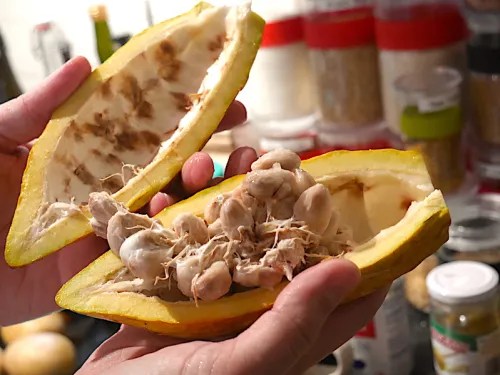
Beans are cleaned by hand, with the baba (pulp) left on to help develop flavor. Exposed to light, the cream-colored beans turn a purplish color.
The milky substance is washed off the beans, after which the beans are put out to dry. Drying is important.
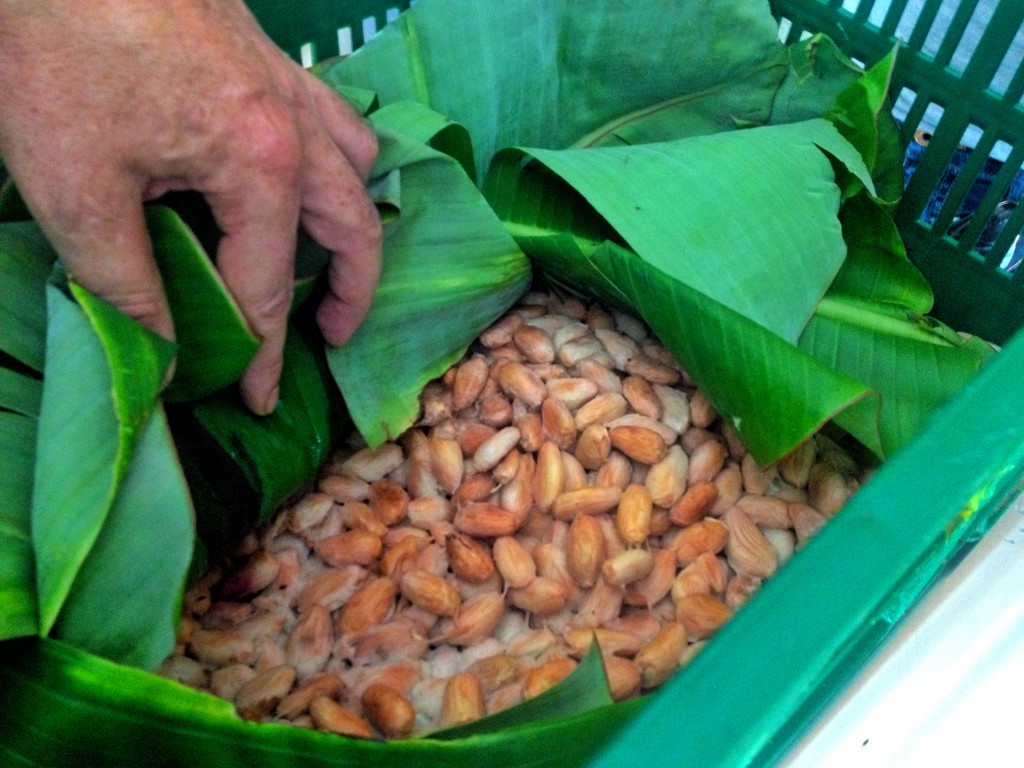
In Latin America, cocao beans are covered with banana leaves. The beans are layered in special boxes that allow ventilation.
The fermentation process lasts between 2-9 days. During this time, the beans begin to take on the dark purple color. They also develop some flavors you would recognize as “chocolate.”
The beans need to be stirred often so that all of them can be dry uniformly.
Notice they are dried in the shade. Outdoors is too much sun.

Market time:
The beans are separated as they dry. Once dried, the beans are graded, packed into sacks, bundled, and checked for quality. They are then shipped and traded on the international market.
Or, in the case of direct trade (for craft, bean-to-bar chocolates), the beans are exported directly to the chocolate maker.
Several chocolate companies source cocao beans directly from farms, including Ferrero, Lindt & Sprüngli, Askinosie, and El Rey. They then process their own way for their distinct flavors.
Processing cocao:
At home, great care is taken with the drying process. The beans must dry on a ventilated platform, out of the sun, and stirred often.
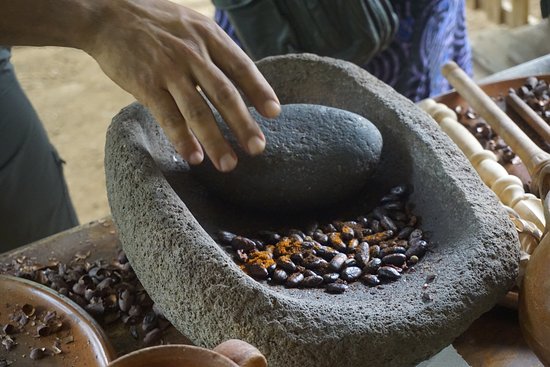
When the cocao is processed at home, after drying, the beans are rolled with a wooden pin or stone. They are crushed into a fine dust. Sugar and Cinnamon is add to this process. This home process is a lot like the manufacturing “conching” which is done by machines.
When the cocao becomes cocoa powder:
The cocao bean has become cocoa powder. With more grinding, the powder changes some more.
Crushing continues until the substance becomes almost paste-like. This is the first chocolate candy. The paste can be rolled together into a ball. And then flattened to make a slab of chocolate!
Sometimes it is just cut and packaged. After all the work: Candy is made!
But this chocolate is oh so good and different from what I would buy in the store. It is not overly sweet. It most definitely tastes of chocolate.
The chocolate that Bob and I tasted was more the raw chocolate candy. Just cocoa beans, sugar and cinnamon. (Butter may develop from all the rolling. Rolling creates a heat that slowly blends the ingredients together.)
The chocolate we can purchase in a store in the USA is much different. It is unlike the natural chocolate found in a Mexican home.
Processing at home:
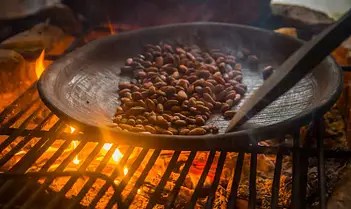
When creating chocolate at home, the beans are still need to be cleaned. They are soaked and stirred and stirred to dry. They are tended carefully.
Then the beans are roasted at low temperatures to develop flavor.
(Illustrated is an at home roasting. )
Shells are separated from the roasted beans (the “meat” of the bean) by a process called winnowing. This is where the chocolate nib is formed.
Nibs are the finely ground cocoa beans. These nibs are ground into a cocoa mass. At room temperature the grinding can result in a solid paste. (Placed under extremely high pressure, this paste yields two products: cocoa powder and cocoa butter.)
The grinding process transforms the cocao bean into cocoa powder. This can be done by hand or machine. Once ground, it is ready to add any flavorings desired.
Cocoa butter happens through more grinding, then pressing out the liquids to separate the cocoa butter from the solids.
The chocolate we buy in the store:
The chocolate production process consists of fermentation, drying, and roasting and grinding.
Mixing of all ingredients, after grinding, is next. (This is the cocoa mass, sugar, cocoa butter, emulsifiers, aroma, and milk components if needed. This is where the individual chocolate companies develop their own flavors.)
Conching (rolling) and tempering complete manufacturing process.
Conching is a vital step in chocolate making that involves mixing, kneading, and grinding chocolate to achieve a smooth and consistent texture. Conching is usually done by machine. The chocolate becomes a very smooth paste.
In Mexican homes, conching is done by hand to create the desired powder. Homemakers add flavorings, such as sugar and cinnamon at this point.
Major chemical reactions occur during fermentation, drying, roasting of cocoa beans, and conching of the chocolate mass. These reactions are the most important for flavor and aroma development. For candy companies this process is done mechanically and under great control.
Once received by the processor, beans may be blended with other ingredients. This creates desired characteristics. Alternatively, they can be kept separate as “single-origin chocolate”.
White chocolate is made with cocoa butter, sugar, and milk powder (but no cocoa mass/liquor). Because it contains no cocoa mass, some do not consider it a true chocolate.
A top ranking superfood!
“Dark chocolate: what was once considered a sweet treat, is now considered one of the top-ranking superfoods.
Chocolate dates back to 2000 BC when the first chocolate connoisseurs drank it as a beverage. Long after, chocolate was revolutionized with the invention of chocolate bars in the 1800s.
Why is dark chocolate healthy?
Chocolate is widely consumed by all generations. It is rich in fat, proteins, carbohydrates, polyphenols and other bioactive compounds [1].
According to hsph.harvard.edu, dark chocolate contains high amounts of flavanols.
Flavanols, which are plant chemicals derived from the cocoa beans, have been linked to protecting the heart from cardiovascular diseases.
Additionally, cocoa is also rich in iron, magnesium, phosphorus, copper and zinc.
It’s no wonder numerous doctors urge individuals to make dark chocolate a part of their everyday diet and nutrition.”
Impressions from our trip to see cocoa produced:
It was most interesting to see how easy cocoa can be “made.” I guess I had no idea where the powder originated. We were surprised at the casual production that happens in a home. Chocolate is sold on the street. It is not governed by the government. It is just a local produce.
Mexico opened my eyes to natural foods. Cocoa was just the beginning for me.
Truly a healthy gift!
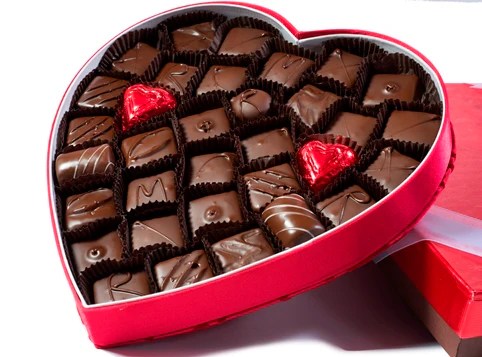
Chocolate has become the candy of choice for Valentine’s Day. We associate it with love.
And to Montezuma’s credit, scientists say that chocolate contains two chemicals. These are Phenylethylamine and Serotonin. They are associated with heightening romantic urges, happiness, and overall energy. They also increase blood pressure and sugar levels which is a similar reaction to those in love.
Why do we love it so? Why do we crave it at times?
It is the chemical Phenylethylamine (PEA), which triggers the brain’s pleasure centers and induces feelings of happiness and excitement. This chemical reaction is similar to the feeling of falling in love, making chocolate an emotionally rewarding experience.
We fell in more in love with chocolate after visiting Mexico by watching cocao being harvested and chocolate candy being made.
Dark chocolate is recommended as a healthy natural treat.
When you buy the box of chocolate, select good quality, and try to add some dark chocolate. Dark chocolate is greater in nutrients than milk chocolate.
By choosing your chocolate gift wisely, you know that you are giving your sweetheart a healthy heart treat!
Happy Valentine’s Day!
https://wellness.maryjessen.com
References:
https://www.lakechamplainchocolates.com/making-chocolate/
https://www.popcornforthepeople.com/blogs/blog/dark-chocolate-health-benefits
 Mary Jessen: Wellness Makes Cents