
Effects of Telomeres on Cellular Aging: Can We Slow Down Aging?
Why are some people aging slower and seem younger than many? Why do some people age quicker than others?
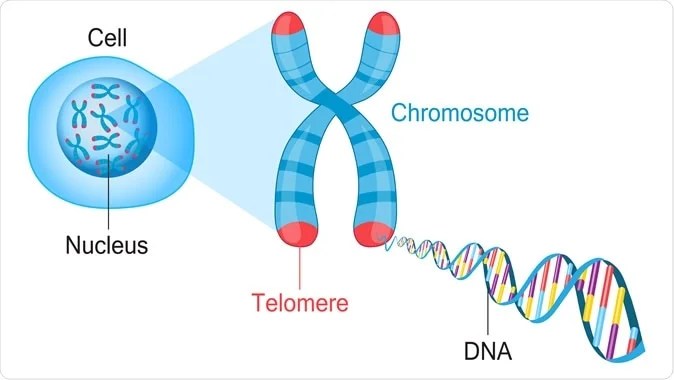
Let’s start by learning about Telomeres, which are found in the genetic heart of your cell: your chromosome. Telomeres live at the end of your DNA. With each cell division, your DNA chromosome gets smaller. These little caps, telomeres, determine how fast or slow you age.
Imagine a shoe lace. The end of a shoe lace has a cap. It is called aglet. It protect the lace from fraying. Your telomere does the same thing to the “lace” of your DNA’s chromosome.
Telomeres listen. And learn. They listen to your body’s instructions as to the way you live. They absorb these instructions. The way you live can speed up or slow down the process of cellular aging. You are born with your own set of genes. But the way you live will influence how your genes react.
Can we help our DNA strands?
The instructions you give your DNA can be good, or bad. The foods you eat influence your telomeres. Your responses to stress play a role. Whether or not you were exposed to childhood stress is a factor. The level of safety in your neighborhood affects your DNA’s telomeres, too. Exercise also has an impact.
Good cellular health tips:
One of the points to good cellular health is to consider is how you manage stress. The outside world can create havoc inside our bodies. This happens when we allow the tension to build and build without a proper release. We need to learn how to handle stress. Our life experiences, and the way we respond to them can actually change the length of the telomere. It can actually change the way we age.
When stress is high, the body produces more stress hormones: cortisol and epinephrine. Your heart beats faster. Your blood pressure increases. Even the Vegas nerve is affected. We all have day-to-day stressors. What is important is to learn how to manage long-term stress. This includes job stress or caring for an elderly sick family member or a sick child. Toxic stress is one that lasts for years.
Finding ways to mentally deal with stress is one of the key factors to better health. We know that. But did you know that it affects us at a cellular level. (I thought it was all about muscles?)
The thoughts in our head really do control our health. Letting your mind wander aimlessly does not help. Your mind needs focus. Read; Study; challenging games all nurture your mind. Multi-tasking is a way of stressful living. Learn to do one task fully at a time. Don’t rehash the past. It’s gone. Learn to focus on today and tomorrow with a positive outlook.
Our mental health is important. It helps our body work with stress. Having a positive outlook for the future and/or the challenges ahead make a big difference. Pessimism does short your telomeres and ends up shortening your life. Anxiety and depression also play a negative role in cellular health. If you struggle with mental health or are living a highly stressful life, please get help.
Physical activity may buffer stress related responses of telomere shortening. Take time for exercise. Take a walk. Join a gym. Exercise will lessen your telomeres stress and help your body deal with the problems through a reduction of cortisol.
Nutrition and your healthy DNA
Nutrition plays an important part. (You knew I’d mention those McDonald’s french fries somewhere! )
The consumption of inflammatory foods can increase the shortening of telomeres. Accelerated shortening of telomeres is associated with early-onset of many age associated diseases. Dr Google says: All processed foods can cause inflammation. They can alter the bacteria that live in our gut. This alteration can interact with our immune system and eventually trigger a response. This can lead to chronic inflammation. (We know that living with chronic inflammation is harmful to our overall health.) Also, avoid sugars and alcohol. Make that cookie a treat. Save that drink for special occasions. Monitor your sugars.
Learn to eat healthy. Not just for your skin, but for all that goes on inside of our bodies. Consume good sources of Omega-3 (salmon, tuna, leafy vegetables, flax oil and flaxseeds.) Consider a supplement as Omega-3 is important to so many areas of your body. Minimize red meats, especially processed meat. Avoid sugary drinks and foods. Avoid processed foods in general. Eating healthy can save you money. You might have to plan ahead, but it is so worth your time and efforts.
Alls well up to a point.
Our body produces a protein that protects the ends of the DNA strand. It produces it in sufficient quantities to rebuild our telomeres; up to a point. As we age, the telomerase in our cells becomes less, and our telomeres get shorter. We can help the production of telomerase through good nutrition, good mental health, and exercise.
Our DNA strands do not last indefinitely. There is a limit to the division and reproduction of our cells. What we want to do is to help our DNA follow it’s genetic path and not hasten the end. We want to enjoy a long life to it’s fullest!
We are learning more and more on how to live a longer, healthier life.
An illustration of a DNA strand and where to find a telomere.

You might want to follow me on my public Facebook page: https://www.facebook.com/wellnessmakescentswithmary
References:
“THE TELOMERE EFFECT” Elizabeth Blackburn PhD, and Elissa Epel PhD. (book)
Telomeres, lifestyle, cancer and aging: https://www.ncbi.nlm.nih.gov/pmc/articles/PMC3370421/
Physical Activity and Nutrition: Two promising strategies for Telomere Maintenance: https://www.ncbi.nlm.nih.gov/pmc/articles/PMC6316700/
Proteins induced by telomere dysfunction and DNA damage represent biomarkers of human aging and disease: https://pubmed.ncbi.nlm.nih.gov/18695223/
Medical News Today: https://www.medicalnewstoday.com/articles/are-telomeres-really-the-key-to-living-longer-youthful-lives
For more information on this webinar you can look into my Wellness Library: https://wellness.maryjessen.com/wellness-webinar
#health #aging #DNA
 Mary Jessen: Wellness Makes Cents