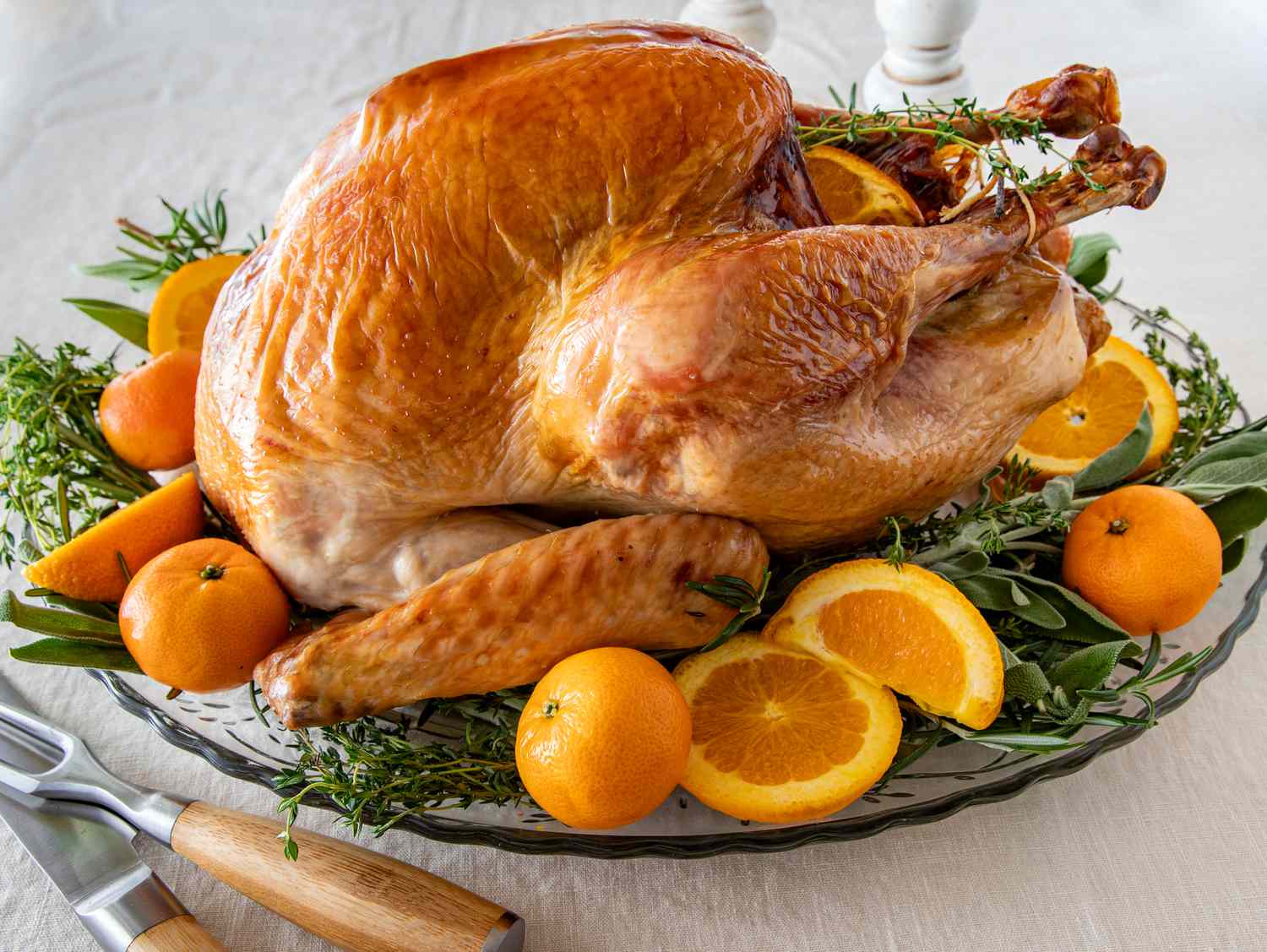
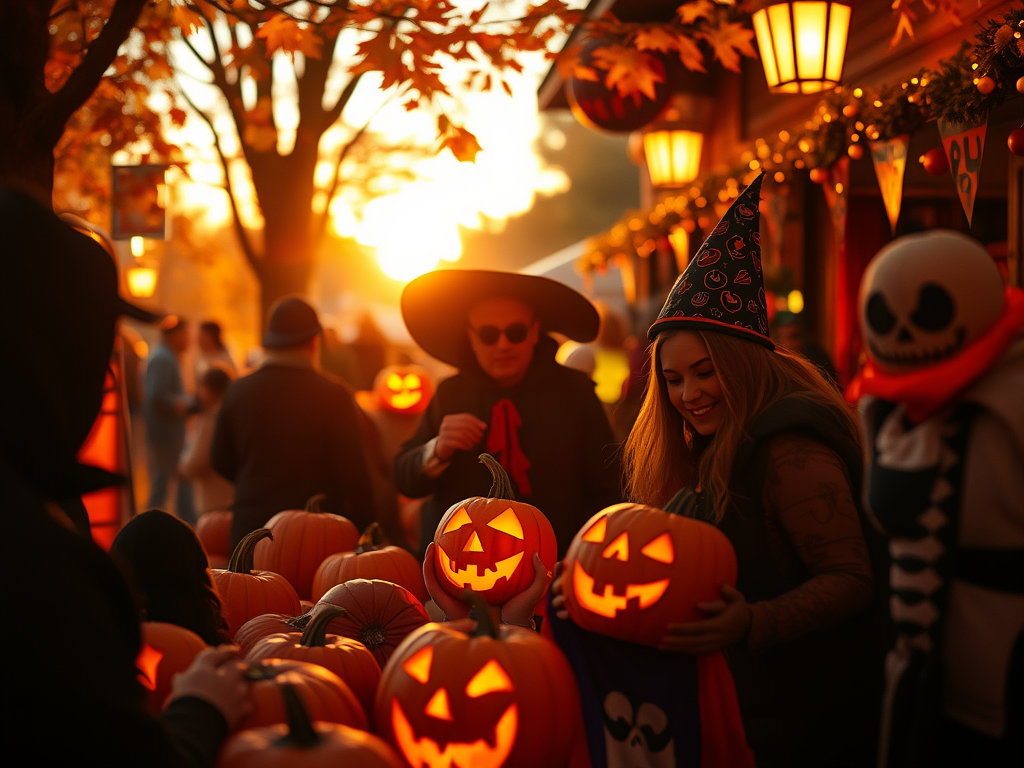
Enjoying the good things in life!

Archive for the ‘History of foods or holiday foods’ Category

How Chocolate Is Made: A Cacao Journey from tree to Valentine!

There is something special about seeing how chocolate is grown. I never imagined it growing on a tree! How did you image cocoa in it’s natural form?

I did not imagine cocoa starting in a pod on a tree. I did not know of the health benefits of dark chocolate. Nor did I imagine it growing in a tropical forest?

On our vacation this past Fall, my husband and I saw how chocolate candy is made. We visited a home in Mexico where cocao was made into chocolate.

I was not aware of all that is involved in creating a piece of chocolate candy. I also did not know what is involved in making a packet of hot cocoa. But we sure did want to see how it was grown.

Wait: isn’t it cocoa?

First let me say it is a Cocao plant, or Cocao Tree.

What is the difference between cocoa and cacao?

The tree, pod, and bean/seed are typically referred to as “cacao.” The word “cocoa” is used to call the bean once it has been fermented, dried, and roasted.

How it all begins:

Chocolate begins with growing on the “cacao tree” (Theobroma cacao). It grows within 20° north and south of the Equator. It thrives on a mix of hot temperatures, a good amount of rain, and oddly also shade.

Cocao is grown in protective pods that form directly on the tree or branch.
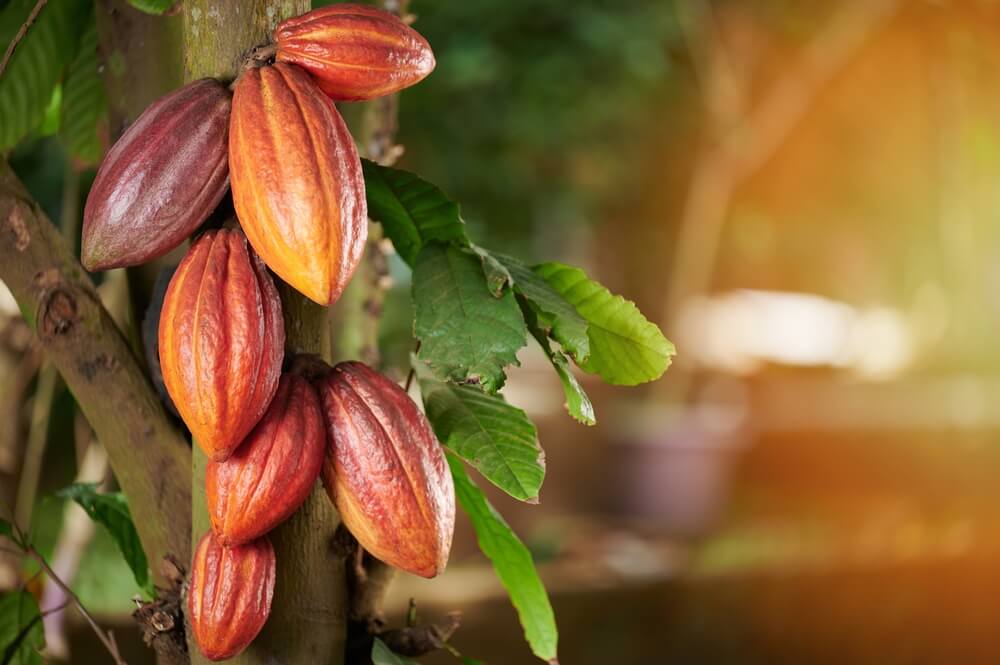
Each tree bears many pods, which are about 5–12 inches long. Each pod contains 30–50 seeds, and it’s these seeds/beans the world knows as cacao (or cocoa) beans.

(Technically what is inside the pod is a seed for the next generation.)

Cacao pods are ripe when they turn a vibrant yellow/orange color. (The pods we saw were yellow, more of pear-yellow.)

The ripening pods hang from the trunk and on the larger branches. The pods hang by small stems. They are typically harvested twice per year. However, they can be harvested continually as flowers and pods can happen at the same time.

Cocao trees grow along-side banana and other fruit trees. These other trees provide some shade and a buffer of rain water for the cocao tree. (Cocao trees need lots of rain, but evidently not direct.)

It is typical to find a Cocao tree in someone’s yard.

Harvesting:

Harvesting is done by hand with a long handled knife. Care is taken not to damage the tree or the pod when harvested.

The pod can easily be opened. Sometimes it opens by just cracking the pods together.

Another method is hitting it with a mallet or knife. (I was amazed to see a gal just knock the pods together and they opened!)

The pod opens up to a milky center where there is a “cone-like” structure that houses the chocolate beans. The beans are covered with a milky substance that is really quite sweet to eat. Bob and I did try this substance. We enjoyed the sweetness. It was kind of a cross between a kiwi and a pineapple, with just a very minor hit of cocoa.

In Latin America, this pulp is called baba. It was used to make a fermented cacao wine as early as 3,000 years ago.

Cleaning and washing:
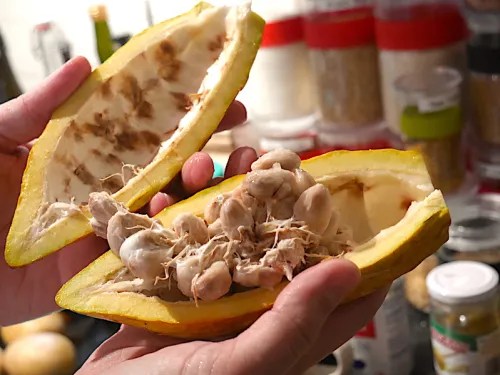
Beans are cleaned by hand, with the baba (pulp) left on to help develop flavor. Exposed to light, the cream-colored beans turn a purplish color.

The milky substance is washed off the beans, after which the beans are put out to dry. Drying is important.
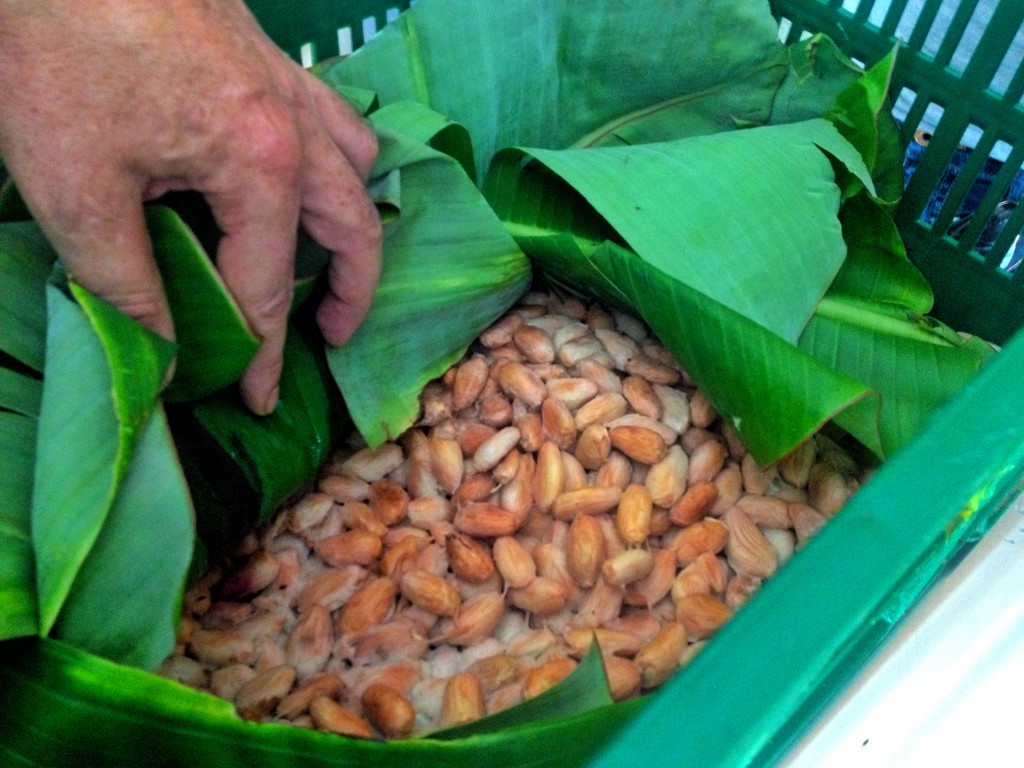
In Latin America, cocao beans are covered with banana leaves. The beans are layered in special boxes that allow ventilation.

The fermentation process lasts between 2-9 days. During this time, the beans begin to take on the dark purple color. They also develop some flavors you would recognize as “chocolate.”

The beans need to be stirred often so that all of them can be dry uniformly.

Notice they are dried in the shade. Outdoors is too much sun.

Market time:

The beans are separated as they dry. Once dried, the beans are graded, packed into sacks, bundled, and checked for quality. They are then shipped and traded on the international market.

Or, in the case of direct trade (for craft, bean-to-bar chocolates), the beans are exported directly to the chocolate maker.

Several chocolate companies source cocao beans directly from farms, including Ferrero, Lindt & Sprüngli, Askinosie, and El Rey. They then process their own way for their distinct flavors.

Processing cocao:

At home, great care is taken with the drying process. The beans must dry on a ventilated platform, out of the sun, and stirred often.
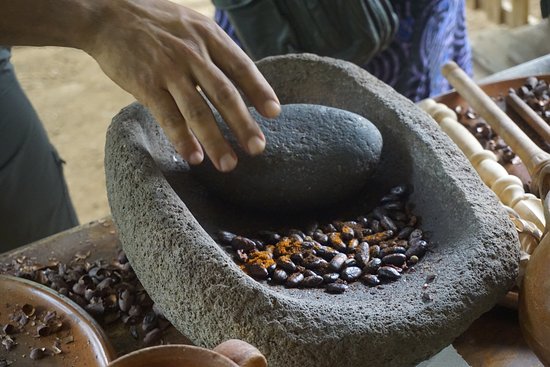
When the cocao is processed at home, after drying, the beans are rolled with a wooden pin or stone. They are crushed into a fine dust. Sugar and Cinnamon is add to this process. This home process is a lot like the manufacturing “conching” which is done by machines.

When the cocao becomes cocoa powder:

The cocao bean has become cocoa powder. With more grinding, the powder changes some more.

Crushing continues until the substance becomes almost paste-like. This is the first chocolate candy. The paste can be rolled together into a ball. And then flattened to make a slab of chocolate!

Sometimes it is just cut and packaged. After all the work: Candy is made!

But this chocolate is oh so good and different from what I would buy in the store. It is not overly sweet. It most definitely tastes of chocolate.

The chocolate that Bob and I tasted was more the raw chocolate candy. Just cocoa beans, sugar and cinnamon. (Butter may develop from all the rolling. Rolling creates a heat that slowly blends the ingredients together.)

The chocolate we can purchase in a store in the USA is much different. It is unlike the natural chocolate found in a Mexican home.

Processing at home:
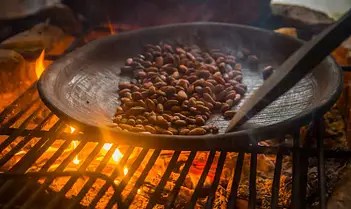
When creating chocolate at home, the beans are still need to be cleaned. They are soaked and stirred and stirred to dry. They are tended carefully.

Then the beans are roasted at low temperatures to develop flavor.

(Illustrated is an at home roasting. )

Shells are separated from the roasted beans (the “meat” of the bean) by a process called winnowing. This is where the chocolate nib is formed.

Nibs are the finely ground cocoa beans. These nibs are ground into a cocoa mass. At room temperature the grinding can result in a solid paste. (Placed under extremely high pressure, this paste yields two products: cocoa powder and cocoa butter.)

The grinding process transforms the cocao bean into cocoa powder. This can be done by hand or machine. Once ground, it is ready to add any flavorings desired.

Cocoa butter happens through more grinding, then pressing out the liquids to separate the cocoa butter from the solids. 

The chocolate we buy in the store:

The chocolate production process consists of fermentation, drying, and roasting and grinding.

Mixing of all ingredients, after grinding, is next. (This is the cocoa mass, sugar, cocoa butter, emulsifiers, aroma, and milk components if needed. This is where the individual chocolate companies develop their own flavors.)

Conching (rolling) and tempering complete manufacturing process.

Conching is a vital step in chocolate making that involves mixing, kneading, and grinding chocolate to achieve a smooth and consistent texture. Conching is usually done by machine. The chocolate becomes a very smooth paste.

In Mexican homes, conching is done by hand to create the desired powder. Homemakers add flavorings, such as sugar and cinnamon at this point.

Major chemical reactions occur during fermentation, drying, roasting of cocoa beans, and conching of the chocolate mass. These reactions are the most important for flavor and aroma development. For candy companies this process is done mechanically and under great control.

Once received by the processor, beans may be blended with other ingredients. This creates desired characteristics. Alternatively, they can be kept separate as “single-origin chocolate”.

White chocolate is made with cocoa butter, sugar, and milk powder (but no cocoa mass/liquor). Because it contains no cocoa mass, some do not consider it a true chocolate.

A top ranking superfood!

“Dark chocolate: what was once considered a sweet treat, is now considered one of the top-ranking superfoods.

Chocolate dates back to 2000 BC when the first chocolate connoisseurs drank it as a beverage. Long after, chocolate was revolutionized with the invention of chocolate bars in the 1800s.

Why is dark chocolate healthy?

Chocolate is widely consumed by all generations. It is rich in fat, proteins, carbohydrates, polyphenols and other bioactive compounds [1].

According to hsph.harvard.edu, dark chocolate contains high amounts of flavanols.

Flavanols, which are plant chemicals derived from the cocoa beans, have been linked to protecting the heart from cardiovascular diseases.

Additionally, cocoa is also rich in iron, magnesium, phosphorus, copper and zinc.

It’s no wonder numerous doctors urge individuals to make dark chocolate a part of their everyday diet and nutrition.”

Impressions from our trip to see cocoa produced:

It was most interesting to see how easy cocoa can be “made.” I guess I had no idea where the powder originated. We were surprised at the casual production that happens in a home. Chocolate is sold on the street. It is not governed by the government. It is just a local produce.

Mexico opened my eyes to natural foods. Cocoa was just the beginning for me.

Truly a healthy gift!

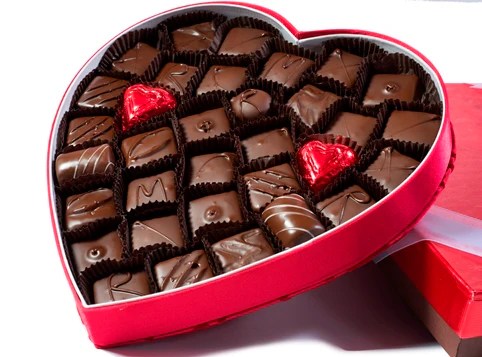
Chocolate has become the candy of choice for Valentine’s Day. We associate it with love.

And to Montezuma’s credit, scientists say that chocolate contains two chemicals. These are Phenylethylamine and Serotonin. They are associated with heightening romantic urges, happiness, and overall energy. They also increase blood pressure and sugar levels which is a similar reaction to those in love.

Why do we love it so? Why do we crave it at times?
It is the chemical Phenylethylamine (PEA), which triggers the brain’s pleasure centers and induces feelings of happiness and excitement. This chemical reaction is similar to the feeling of falling in love, making chocolate an emotionally rewarding experience.

We fell in more in love with chocolate after visiting Mexico by watching cocao being harvested and chocolate candy being made.

Dark chocolate is recommended as a healthy natural treat.

When you buy the box of chocolate, select good quality, and try to add some dark chocolate. Dark chocolate is greater in nutrients than milk chocolate.

By choosing your chocolate gift wisely, you know that you are giving your sweetheart a healthy heart treat!

Happy Valentine’s Day!
https://wellness.maryjessen.com

References:

https://www.lakechamplainchocolates.com/making-chocolate/

https://www.popcornforthepeople.com/blogs/blog/dark-chocolate-health-benefits
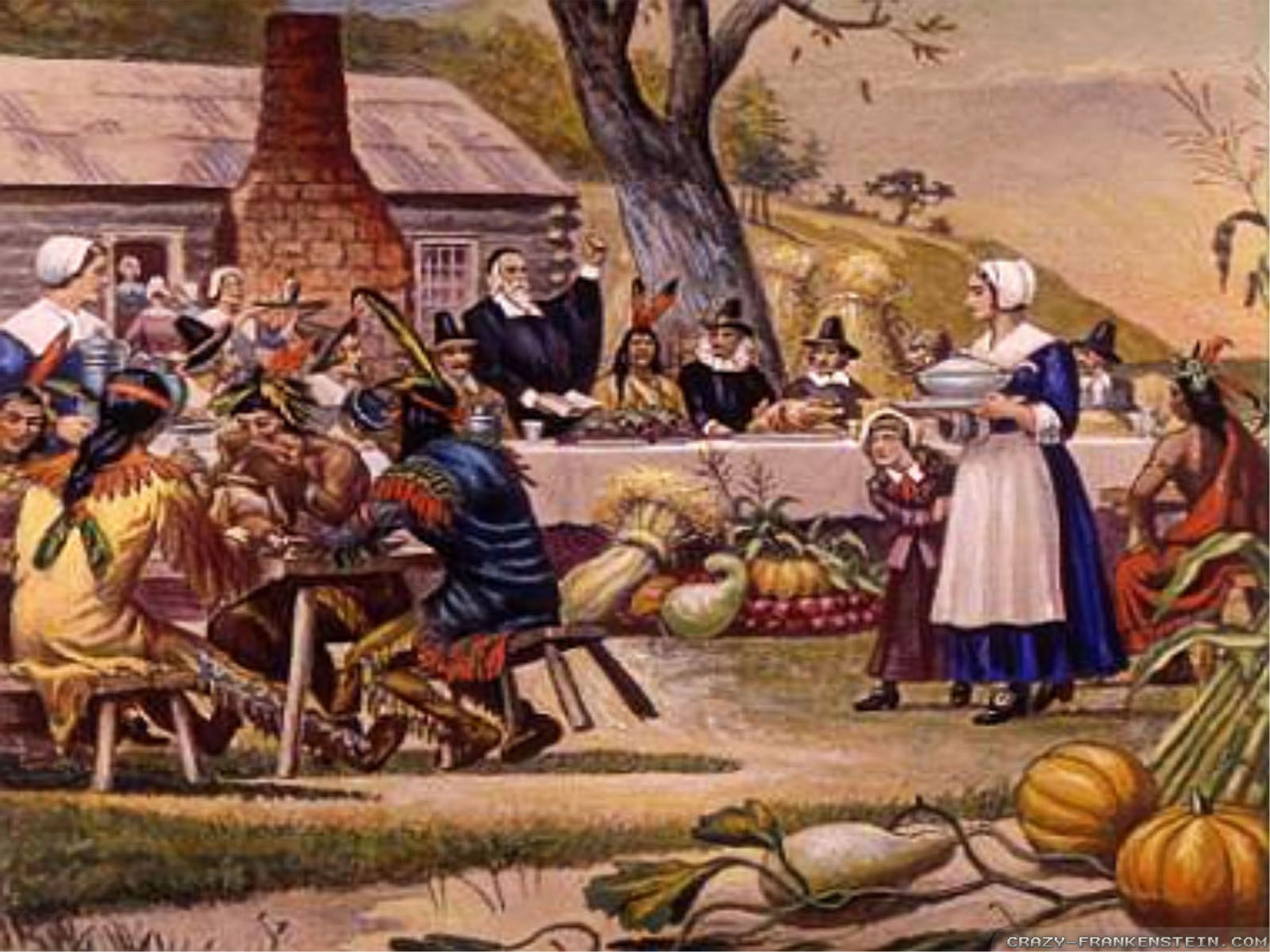
The Real History of Thanksgiving: Myths & Truths

What is the history of Thanksgiving?

Was it a grateful celebration? Or was it something entirely different?

Many holidays we celebrate have great history. Some holidays have a distorted history. I’m hoping to pass along the real stories of how America was settled and the how the First Thanksgiving was celebrated.

When did the Thanksgiving Holiday start?

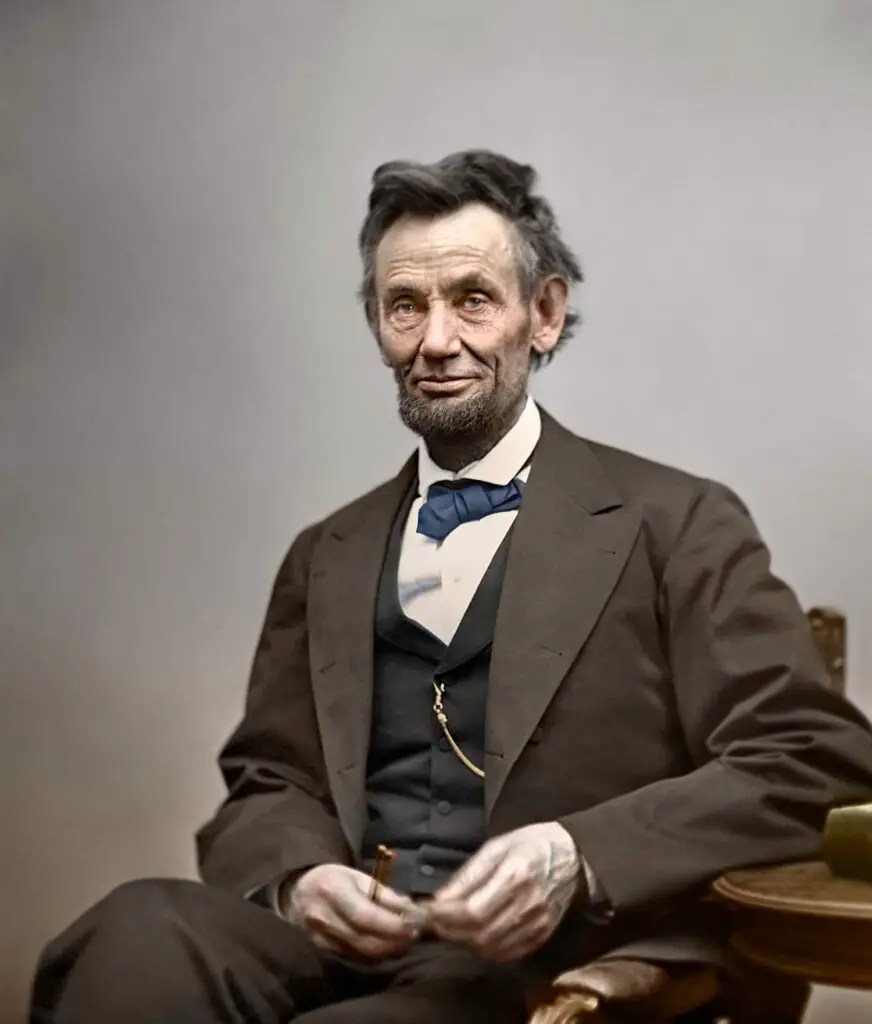
The formation of Thanksgiving as an official, United States holiday, did not happen until November 1863, during the Civil War. President Abraham Lincoln officially established the holiday to improve relations between northern and southern states.

“It was propaganda,” it is explained. “The proclamation of the holiday was aimed to build an event of community. The goal was to create a deeper narrative about community building. It was about coming together in shared brotherhood and unity.”

The Thanksgiving of today is not an absolute factual event. There were many “thanksgiving” meals across found in North America, European cultures, and other cultures of the world.

In ancient times, Egyptians, Greeks, and Romans paid tribute to their gods for a good harvest. Our Thanksgiving also bears a resemblance to a Jewish harvest festival of Sukkot. It was simply a meal shared with friends and family after harvest. Sometimes there was a celebration of the harvest.

Who were the first settlers?

It was 1498. John Cabot worked for King Henry VII of England. Six years had passed since Columbus landed in the West Indies. Cabot was an Italian sailor who sailed into North American waters. He may have explored the Maine coast. However, there is no concrete evidence of it.

A century after Cabot’s voyage, several European ships briefly visited the area. Some of them put ashore to make repairs. Others processed fish catches.

The Plymouth Company established the first settlement at Popham, Maine, in 1607. This was the same year as the settlement at Jamestown, Virginia. The Popham colony didn’t survive the harsh Maine winters. Therefore, Jamestown, Virginia, enjoys the distinction of being regarded as America’s first permanent settlement.

Florida, Maine, Texas, and Virginia have each claimed sites of the First Thanksgiving in North America.

Europeans had been living and working in North America for many years prior to the Pilgrims.

It is said that the First Thanksgiving occurred on May 27, 1578, in Newfoundland Canada, and was held by Europeans. However, some believe the colonists of the Popham Colony in Maine may have conducted the first Thanksgiving service in 1607.

Fishing vessels with Basque, English, Portuguese, French, Dutch and Spanish crews were making seasonal expeditions. Basque vessels had been fishing cod shoals off Newfoundland’s coasts since the beginning of the 16th century. Their crews used the natural harbor at Placentia. French fishermen also began to use the area. The Pilgrims were not first on the land.

What is a “pilgrim?”

By definition, a Pilgrim is one who searches for religious freedom. By nature they are not explorers. The Pilgrims were primarily Puritan. Consequently, they were not exactly friends of the English church. Puritans held strong Calvinist Protestant beliefs. They aimed to completely eradicate traces of the Catholic Church and the English or Anglican Church. They were out to spread their beliefs to everyone, especially the heathens of North America.

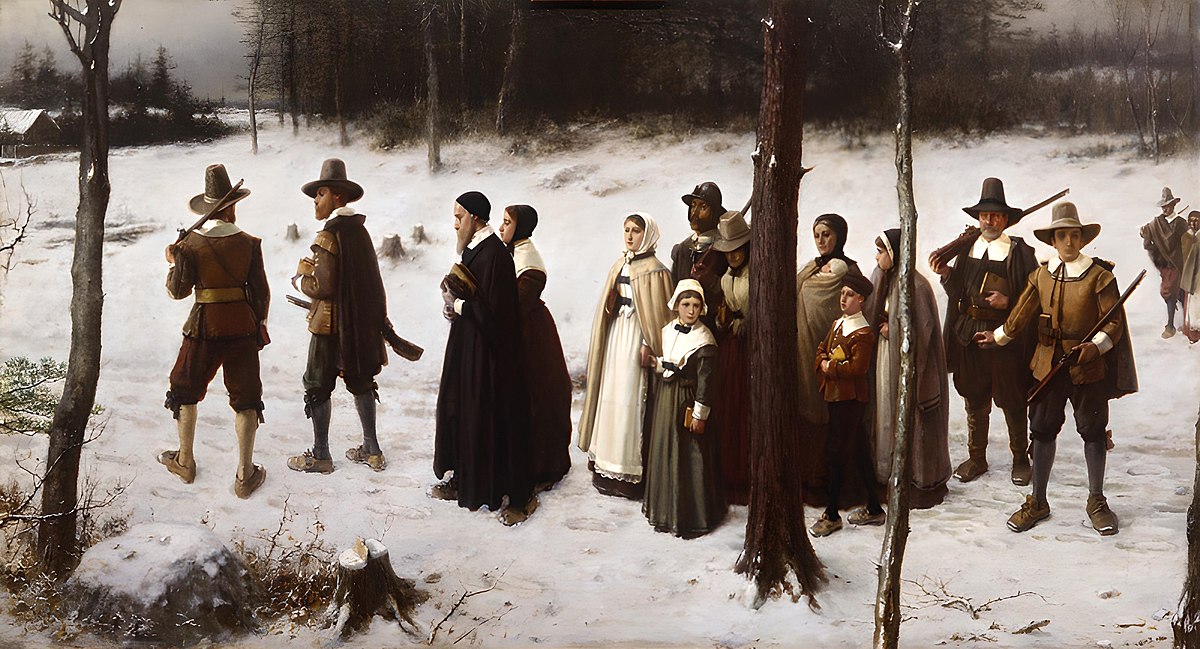
The Mayflower set sail on 16th of September 1620, from Plymouth, UK, for a voyage to America. But its history and story start long before that. Its passengers were in search of a new life. Some sought religious freedom. Others were looking for a fresh start in a different land. Some dreamed of great wealth.

Many Pilgrims were seeking a place to freely practice their faith. Others were lured by the promise of land ownership and prosperity in the “New World.” Some were desperate to leave due to persecution.

Mayflower finally lands, but not where they wanted to go.

When the Mayflower landed after along trip of 66 days, November 9, 1620, only 53 of the 102 passengers survived. They did not land at Plymouth Rock. The English really intended to land south of the Hudson River, somewhere in New Jersey, a warmer harbor. However, a storm blew the ship off-course. It put them ashore off Cape Cod harbor, Maine, in a dark and very cold winter.

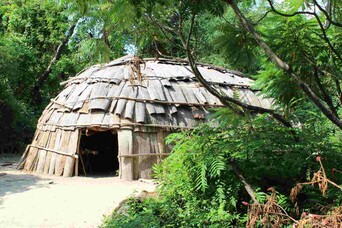
The Pilgrims first had to find shelters for their winter ordeal, and find water and food. It is recorded that some stayed in abandoned Native American’s lodges. Throughout the first winter, many Pilgrims suffered from weather exposure, scurvy, and outbreaks of a contagious disease.

Unfortunately, the Pilgrims had no knowledge of the local wildlife. Even if they did, they lacked the knowledge of how to capture it, nor the tools to hunt. They had left in haste, and did not pack well. Nor were they aware of what was needed.

(Half of the landing party died that winter. If the Pilgrims were not the very first settlers, why was there no knowledge of what to expect? Some say it was due to the hasty departure to avoid persecution in England.)

The Mayflower sailed back to England in the spring of 1621. Despite the hardships of the winter, none of the Pilgrims returned with the ship. The Mayflower resumed transporting cargo, never returning to Plymouth. By 1624, the Mayflower’s sailing life was over and the ship was described as being “in ruins.”

It was April of 1621 when Samoset, a Native Abenaki Indian, entered the village. Samoset, who spoke English, greeted them by saying “Welcome!”

(Samoset had learned English from interactions with an English fishing camp established in the harbor. Samoset was a lesser chief of the Abenaki people. He often sailed with Captain Dermer, a regular explorer of the region.)

Who was Squanto?

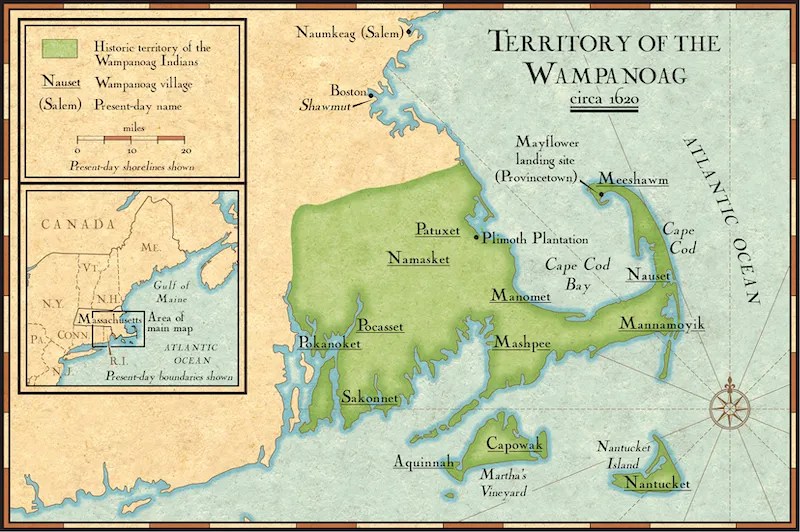
Several days later after Samoset welcomed the Pilgrims, Samoset returned with Squanto, a member of the Pawtuxet tribe. (Squanto was living with the Wampanoag tribe as his entire tribe had been wiped out due to an epidemic.)

The story is true that the early settlers could not have survived without the aid of Squanto and the Wampanoag tribe. As said, they were ill-prepared to fend for themselves. The Wampanoag tribe taught the Pilgrims how to hunt for food in the winter.

(Did you ever wonder how Squanto could communicate with the Pilgrims? An Englishman kidnapped him in 1614. Along with two dozen others, and he was taken to Spain to be sold into slavery.

Squanto escaped captivity, possibly with the help of Catholic friars. He made it back to America, only to discover he was the only survivor of his village. An epidemic had swept across the New England area while he was gone.

Samoset could also speak English. Many years earlier, many Native Americans had been kidnapped and to be sold in England. Samoset was also one of those kidnapped.)

(Interesting that both men were able to escape England and return to America. I was unaware of kidnapping of Native Americans many years before the Pilgrims. Weren’t we taught that it was the Pilgrims as the very first settlers?)

Squanto helped the settlers, in the Spring, by teaching them how to plant corn and other vegetables. With the first harvest, the settlers decided to have a thanksgiving feast in celebration of a good harvest.

Squanto also showed the Pilgrims how to extract sap from Maple trees. He taught them how to catch fish in the rivers. Squanto, also, pointed out which poisonous plants to avoid. He helped forge an alliance between the Wampanoag tribe and the Pilgrims.

Unfortunately the time Squanto works with the Pilgrims is short as he dies from a disease two years later.

(Years later, 1676, the English sold many Wampanoag men into slavery in Bermuda, the West Indies, or on plantations and farms run by colonists in New England. It was not unusual to kidnap Natives and sell them into slavery.)

Very tough times.

The Wampanoag people, the “People of the First Light,” played a crucial role. They saved the Pilgrims from starvation and death during the harsh winter of 1620–21.

The first Pilgrim homes were most likely abandoned Native American villages. Here many also caught the diseases that killed the original inhabitants.

Diseases such as smallpox, bubonic plague, and chickenpox were introduced by the European fishermen. Measles, diphtheria, influenza, malaria, scarlet fever, typhoid, tuberculosis, and pertussis were also introduced.

These were diseases to which Native people bore no natural immunity. Prior to the arrival of European colonist/ fisherman, Native people were plague free. These European diseases killed many many Native Americans.

It was a very tough living those early years. Children worked alongside their parents. Many suffered from the great burdens of creating a village. It was not unusual for a child to die due to hard labor, disease, or the cold.

The Pilgrim’s dream was to bring the Gospel of the kingdom of Christ to remote parts of the world. But they were ill prepared to do that.

The first Thanksgiving was not the first.

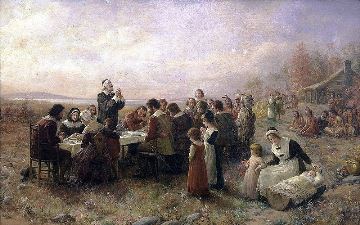
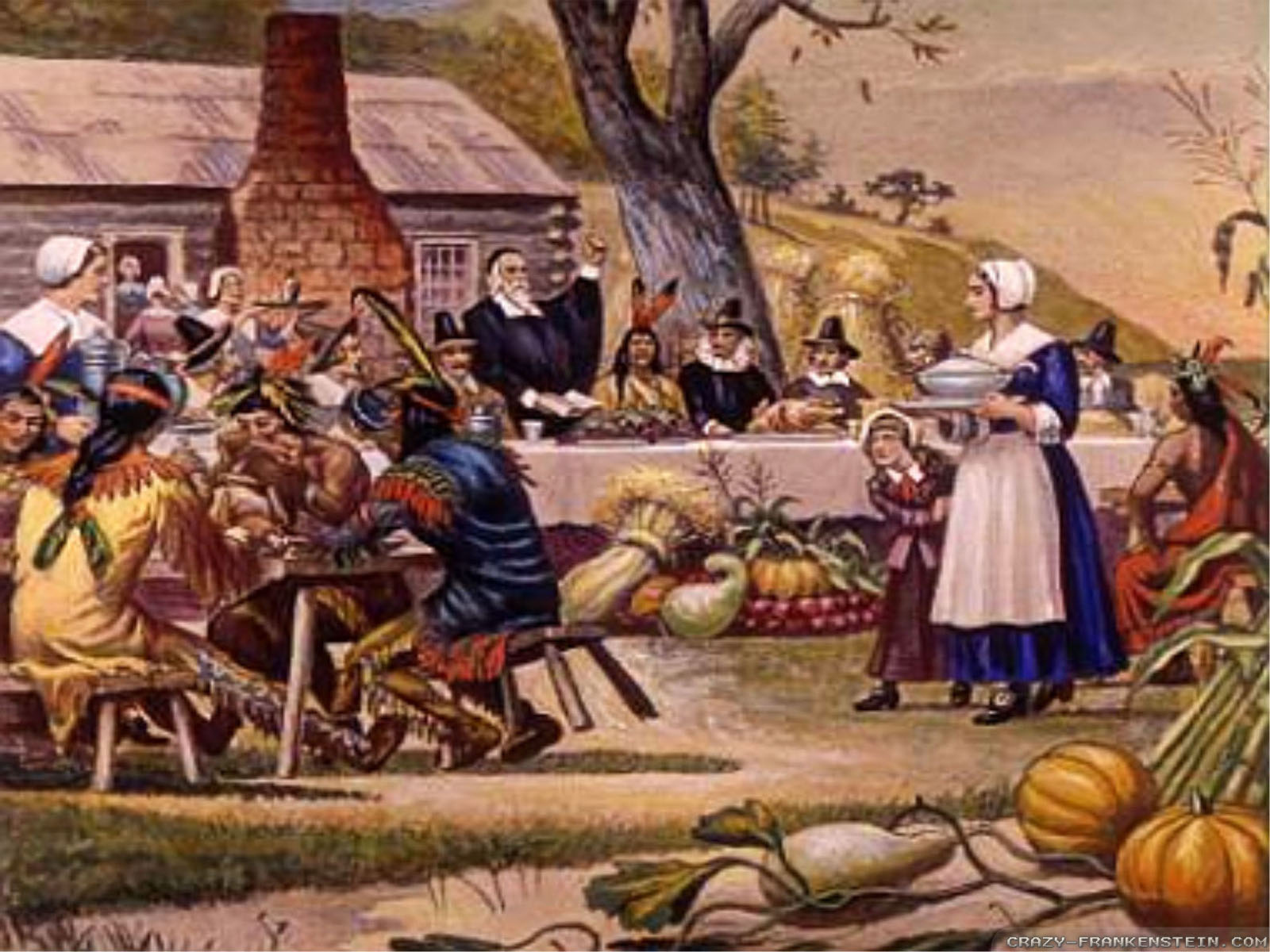
There were many Thanksgiving services in America long before the Pilgrim’s celebration of 1621. The first Thanksgiving, with the Wampanoag tribe, was a non-religious feast, that took place over three days. Games were played. Alcohol was consumed. Indians were present. But they all did not eat together.

Most of the dishes were likely prepared using traditional Native American spices and cooking methods.

In 1623, the Pilgrims at Plymouth Plantation, Mass. held another Thanksgiving celebration. The colonists were praying and fasting for rain as a drought had consumed the area. The rains did come a few days later. And the Dutch supply ship arrived.

It was June 30, 1623, when the Dutch supply ship arrived. The colonists held a day of Thanksgiving and prayer. This festival seems to be the start of Thanksgiving becoming a religious and social event for the Pilgrims.

Europeans brought diseases to the Native Americans.

Prior to European arrival, America’s Indigenous nations did not experience illnesses attributed to livestock, overcrowding, or poor hygiene or sanitation.

“Residents of northern Europe and England rarely bathed. They believed it was unhealthy. They also rarely removed all of their clothing at one time. They thought it was immodest.”

“The Pilgrims smelled bad to the Indians. Squanto ‘tried, without success, to teach them to bathe,’ according to Feenie Ziner, Squanto’s biographer.”

In fact, three years before the pilgrims landed, English and French fisherman transmitted diseases to tribes. They came ashore to find fresh water and firewood. They also captured Native Americans for the slave trade. And they left behind great illness for Native Americans.

It was not easy. Tens of thousands of Native Americans and Europeans died during this time from plague. (This was the time of Squanto held captive in Europe). The plague wiped out a vast majority of the inhabitants of coastal New England. Within 3 years, 90 to 96 percent of them were gone. This was a death rate unknown to man.Those living in the area perished from conflict, conquest, and diseases. (When Squanto returned to American, his tribe was gone.)

Those who did survive left their communities to join others, bringing the illnesses along with them. This caused many Native Americans to perish, even though they had not encountered Europeans.

Religion and exploration and conquer.

Throughout history, religion has served as a justification, and for the English Separatists, it was no different. They believed the wide-spread death and devastation of Native Americans due to disease was divine provenience. They thought God willed them to take over the land.

“By the time the Native populations of New England had replenished themselves to some degree, as so many had died from plagues, it was too late. Native Indians could not expel the intruders.

Colonists occupied lands cleared by Indian farmers who had vanished. As a result, colonization proceeded much more quickly. Native Americans endured devastating physical assaults, particularly from European plagues. If disease and plagues had not happened, the colonization of America would have been quite different.

(Interesting how great illness can shape history. The Pilgrims easily settled in their first years with little conflict of natives. (The local Native American tribes were generous and welcoming.) The widespread death of the Native Americans caused this lack of conflict. Introduced European diseases were responsible for many, many, many deaths.)

It was a very tough time of conquer for the Native American Indian. Colonization brought much death to the natives. It was an awful price to pay for the Pilgrims goal of religious freedom and wealth.

Foods of the first Thanksgiving:

It is noted that the Indian tribe, Wampanoag, arrived with five deer at the first Thanksgiving. The deer were roasted on an smoldering fire pit. Perhaps some of the meat was used for a stew.

Local vegetables were onions, beans, lettuce, spinach, cabbage, carrots, and perhaps peas. Corn was removed from the cob and made into corn meal. This corn meal was boiled and pounded into a corn mash, with a molasses sweetener.

Fruits included blueberries, plums, grapes, gooseberries, raspberries, and cranberries.

It is believed that much of the Thanksgiving meal consisted of seafood. Mussels, lobster, bass, clams, and oysters might have also been a part of the meal.

Potatoes had no place in the meal. It was the Spanish that introduced the potato to Europeans in 1570. Plant roots that were eaten included: Indian turnips, and groundnuts. (A “groundnut” is a variety of roots and tubers. It also includes leguminous crops similar to peanuts. These mature and ripen underground.)

Pumpkin was not served due to a lack of butter and wheat flour. And the settlers had yet to construct an oven for baking. Some say that settlers hallowed out the pumpkin. They may have filled the shell with milk, honey, and spices to make a custard. Then, they roasted the pumpkin whole in hot ashes.

If the harvest was good, there was plenty to eat.

It is said that this “first Thanksgiving meal” the colonists were outnumbered by Native Americans two to one. The Native Americans knew this type of feast well. It was central to their regular spiritual practices. They held these feasts to give thanks for a natural bounty. (Native Americans did not eat at the same table as the settlers.)

Today’s Thanksgiving:

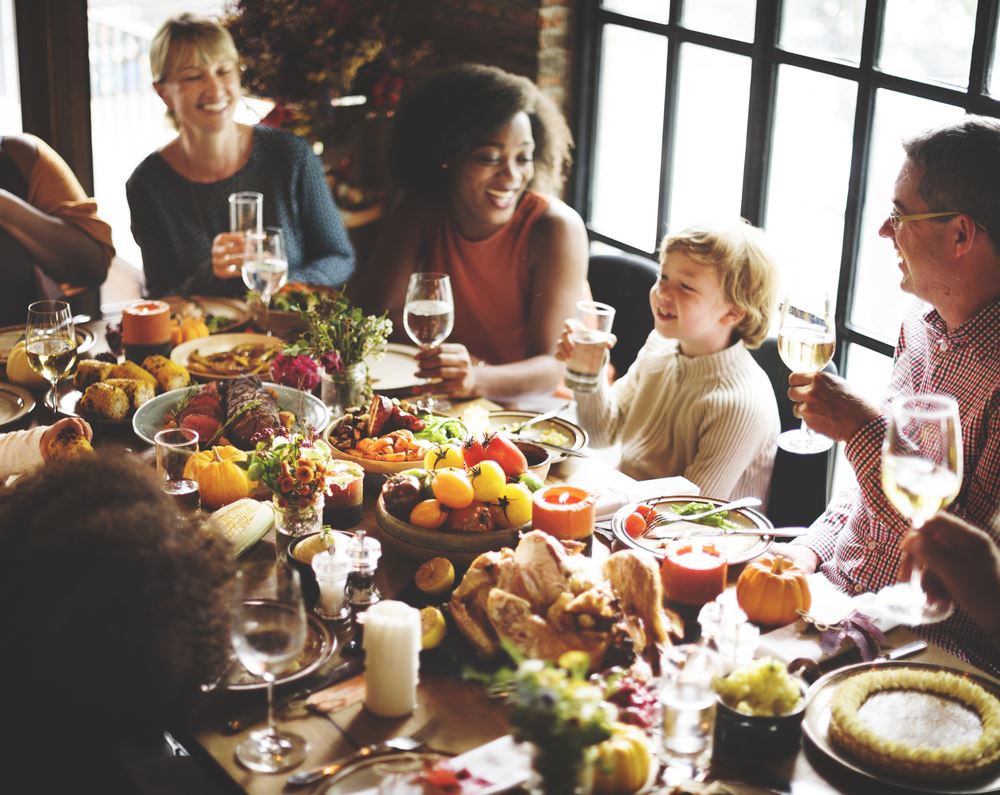
Today, Thanksgiving is a time for families to gather together. Many churches offer special services. We all need to thank Native Americans for the opportunity to celebrate. Without their guidance, early Pilgrims would not have made it.

For some scholars there is still an argument as to whether the Pilgrims really had the first Thanksgiving. History has recorded other Thanksgiving meals among European (Spanish) settlers in North American before the Pilgrims celebration.

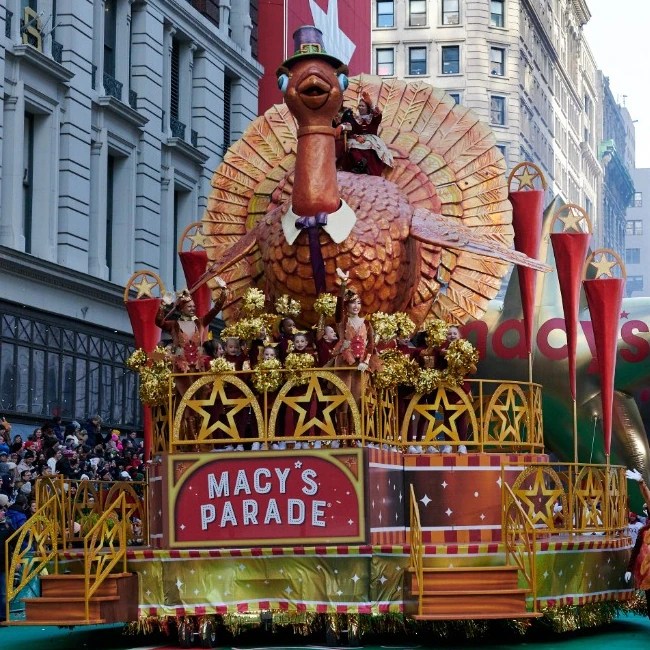
Macy’s Thanksgiving Parade, a part of today’s Thanksgiving celebration.

What would Thanksgiving be like in the 20th and 21st century without the Annual Macy’s Thanksgiving Day Parade?

Parades have always been a part of a citys’ or nations’ celebration. Macy’s Thanksgiving parade started in 1924. It is the largest and most famous, attracting 2-3 million spectators along it’s 2.5 mile route. It also draws an enormous television audience. We all have our favorite bands, performers, floats, and giant balloons each year.

Thanksgiving Controversy.

A Thanksgiving meal holds a long tradition. We all look forward to the celebration of, perhaps, turkey and all the trimmings. We volunteer in food banks so that many can also enjoy the meal. Many families take days to prepare for this meal. Pumpkin pie is a tradition for many. We forget how this holiday came to be. We may not know of who sacrificed so much that today we can give Thanks.

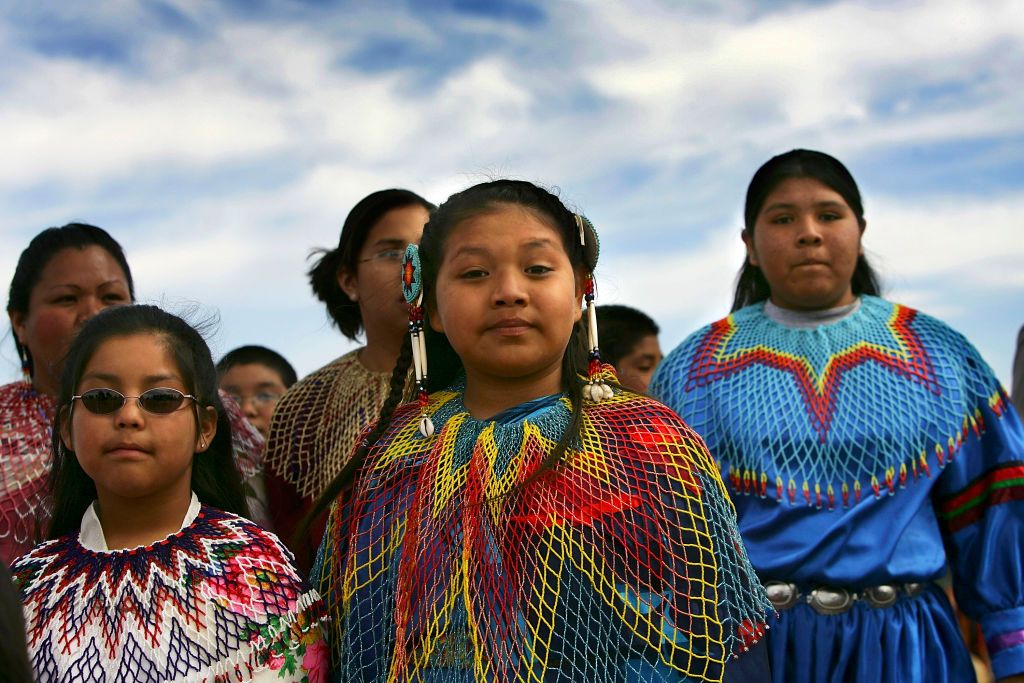
Why don’t we thank Native Americans for their role in our History?

Here in America, Native Americans take issue with the Pilgrim story. It masks the long and bloody history of conflict between Native Indian tribes and the European settlers. This conflict resulted in tens of thousands deaths from both sides.

We need to be aware of the needs of Native Americans today. We have forgotten them. Use Thanksgiving to pray for them, and consider a donation to a local tribe. Every state has a local tribe. They are there.

We need to remember that Native Americans helped us celebrate a “first” Thanksgiving. We also need to teach this to our children. It was a very difficult time for an ill-prepared group of Pilgrims and Europeans.

The Pilgrims intended to convert the “natives” to their religion. They had no regard for what the Native Americans had been practicing.

It was all about the Puritan way as the ONLY way to God. Today I think we are aware that there are many religions that pay homage to God, but in different ways. We are not to judge who is the better way.

What to share with our children today:

Teach our children that a Thanksgiving meal is a special celebration for everyone’s family.

Teach our children how much Native Americans gave of themselves, their cultures, their homes, their traditions in the conquest of North America.

Teach them that the Native Americans really suffered for all their help in the conquest of settling North America.

Teach our children to respect others and their beliefs. Let’s also give thanks for the help of Native Americans in settling North America.

And help your family to remember others at Thanksgiving.

Happy Thanksgiving!

This special occasion unites families and friends. We create cherished memories as we gather around the table to enjoy a feast filled with delicious dishes.

It’s a time for gratitude, reflection, and celebrating the abundance in our lives, while also remembering those less fortunate. It’s a time to think about how this holiday began.

As we share laughter and stories, let us appreciate the meaningful connections we have and express our heartfelt thanks for the blessings that enrich our lives.

References:

https://https://www.potawatomi.org/blog/2020/11/25/the-true-dark-history-of-thanksgiving/

https://www.history.com/topics/thanksgiving/first-thanksgiving-meal

The Fascinating History of Halloween Traditions/Can Halloween be healthy?

Happy Halloween!

This holiday did not start out as fun. It has a very spooky history.

Cost of Halloween:

Halloween spenders spend 11.6 Billion dollars! with 3.8 Billion dollars for costumes. And it is said: $3.1 Billion on candy! 1

Christmas is number one expensive holiday, followed by Thanksgiving, with Halloween being third!

The average expense of Halloween is $103.63 per person. Most of the money is spent on costumes. (This year the cost of candy may become second for sure!)

History of Halloween:

I always want to know the history of an annual event. Especially when it is a holiday celebrated by so many people.

Halloween is among the oldest traditions in the world! This holiday touches on the relationship between the living and the dead. It evolved from ancient rituals honoring the transition from Spring to Winter, from living to dead.

Every recorded civilization has some ritual observance for when people die. They have beliefs about where people go after death. Most civilizations have had ways to honor the dead. Some of the traditions in the US can be traced back to the Celtic festival of Samhain.

Controversy over a claim:

Some believed SamHain was the Celtic God of the Dead, and Halloween was his feast day. It was the Christian church of Northern Europe that changed the observance of this pagan holiday. The Church transformed the pagan rite into a secular holiday.

How were the Druids involved?

Perhaps you’ve heard of the Druids and their practices. Interesting is the fact that they also included stocking supplies for the winter, slaughtering cattle (later to eat?), disposing of the bones in a “bone fire,” later to be called a bonfire.

Gatherings of communities feasted and drank alcohol on this holiday. During all this, people were aware of this being the “thin time” of the year. This was the time for the possibility of ghosts showing up at the party. This was the “thin time” of year between living and dead.

The “thin time” of the year:

The phrase “the veil is thin” or “thin time” of the year is deeply meaningful. It reminds us of the profound spiritual significance of Halloween. It supposedly is a time to connect with our ancestors. We can seek guidance from our angels, guides, and ancestors. We can also explore the mysteries of the spiritual realm.

During autumn, the life of the plant returns to the soil. It goes there to sleep in the cold time of winter. Autumn completes the life cycle of the plants.

Thus it is a time to reconnect with loved ones. Life around us is withdrawing. Autumn is a season of transformation from living to the dead/sleep of winter. (As spring is the opposite: a time of new life.)

The “Hunter’s Moon” of October:

The Hunter’s Moon of October encourages a positive mindset for the dark months ahead. (This year’s Hunter’s Moon was exceptional! And if you think of the connection of the name “Hunter’s” moon, it can also associate with preparing for winter.)

The departed were expected and welcomed at this time of year. People practiced setting out favorite foods for the departed loved one.

It was the Irish who also added that elves, fairies, and “wee folk,” sprites, and dark energies could also appear.

How did masks become a costume of Halloween?

People believed in spirits. There was a good chance the spirits were souls who had wronged someone. To deceive the spirit, people of that time, would darken their faces with ashes from the bonfires.

This practice developed into wearing a mask. Druids even wore animal skins to drive away phantoms; some began dressing as ghosts, demons and other malevolent creatures.

And then it became Christianized.

It was in the 8th century that Pope Gregory III designated November 1 as the “Feast of the Souls.” Some scholars claim this was done intentionally to Christianize SamHaim by turning it into “All Hallows’ Eve.”

Once Christianized, “All Hallows’ Eve” became a night of vigil. People engaged in prayer and fasting. They prepared for the next day when the saints were honored. It was a time of honor and prayer. It was a time of prayer and honor of the dead.

The jack-o-lantern.

The jack-o-lantern is linked to an Irish folktale of Stingy Jack. He was a clever drunk and con man that fooled the devil into banning himself, Stingy Jack, from hell. But because of Jack’s sinful life, he could not enter heaven.

After his death, Stingy Jack roamed the world carrying a small lantern. It was made of a turnip with a red-hot ember inside to light his way.

Turnips for lanterns!

On All Hallows’ Eve, the Irish hollowed out turnips. They carved faces into them. They placed a candle inside so they would be protected from the spirits of Stingy Jack. There was still a belief that the veil of between life and death which was the thinnest on that night. Spooky!

Shortly after emigrating the the United States, the Irish traded the turnips for pumpkins as their lantern of choice.

The history of trick-or-treating can be traced back to Scotland and Ireland.

(Have you ever asked the ‘trick or treaters” to perform a trick? It is a fun reaction!)

First “souling” than it became “trick or treat!”

Was there always a trick or treat Halloween in the USA?

In the mid 19th century, immigrants fleeing the Irish Potato Famine brought Halloween to the United States. This famine included the countries of Ireland and Scotland.

In the early 20th century, Irish and Scottish communities revived the tradition of “souling.” “Souling” involved asking for donations of food. Instead of pledging to pray for the dead, they would sing a song, recite a poem, or tell a joke. They might also perform another sort of “trick” before collecting their treat. The treat typically consisted of fruit, nuts, or coins.2

The haunted history of Halloween costumes.

They also revived “guising,” which means dressing up as evil or frightening characters.

By the 1920s, pranks had become the activity of choice for young people.

The Great Depression increased the Halloween mischief into vandalism, physical assaults, and sporadic acts of violence. It is believed that this type of mischief led to the adoption of Halloween community based activities.

The Birth of Halloween Parties:

Elizabeth Krebs was frustrated. It was the morning after Halloween. Her garden and the town’s gardens were in shambles again after October 31. Children did the vandalizing, wearing masks so no one would recognize them.

The next year, 1913, Ms Krebs made a decision. She would use her own resources to organize a party for the young people. She hoped that the vandalizing would stop. She hoped to tire the children enough that they would go home to bed and no more vandalizing.

From failure to success:

But it didn’t work. Perhaps it was too small a scale. The next year in 1914, the whole town decided to get involved. A costume contest was held. A parade was designed. Her plan worked! Their gardens survived!

The success of Ms Krebs idea took hold and soon after many other towns followed suit. They held costume contests, parades, music, food, dancing, and sweet treats, all accompanied by frightening decorations of ghost and goblins.

Ms Krebs is sometimes cited as the “mother of modern Halloween.”

Trick or Treat was interrupted by WW II, as sugar was rationed. It re-emerged again after the war. The familiar tradition of today dates back to the 1950s where costumes became mass produced. (I remember plastic costumes and plastic facial masks.)

Today Halloween is focused on the young. We celebrate with trick or treat. We wear costumes most likely of Disney characters. We give out candy to children and hold Halloween parties. Halloween has finally gotten quite civilized!

A hallowed Night of Transformation:

A mask or costume can transform a person into another entity. For one night, your child or you can become Darth Vader. You can also become Dora the Explorer, a fairy, a princess, Superman, or even a zombie!

The costumes of today represent the fears and hopes of the wearer. People of long ago wore masks to deter unwelcome spirits. They also anticipated the joy of a reunion with the dead. Today we wear costumes for fun with very little thought to what they represent.

Traditional Halloween Foods!3

Every holiday has its special foods. Halloween is not an exception.

Countries have different traditional Halloween foods. (Interesting. I did not know that!)

PUMPKIN PIE is in first place in the US for traditional Halloween dessert. And you thought it was only for Thanksgiving!

Pumpkin pie is recognized around the world. It consists of a crusty pie with a spicy pumpkin filling. Easy to make, and available to buy!

PUMPKIN BREAD is another reminder of Halloween and fall. Spicy and crispy-crusted loaf to be served with or after a Halloween dinner. (I bet it would be good with cream cheese!)

CARAMEL APPLES: Everyone enjoys caramel apples! A basic dip for the apple is in sugar, water and corn syrup. And you can add or dip, the apple, into different coatings: nuts, chocolate, or sprinkles!

APPLE BREAD: a delicious way to use apples. Mix the dough ingredients and top with brown sugar coated apple slices.

CARAMEL CORN: A simple sweet snack with popcorn and brown sugar, butter, corn syrup, vanilla, and baking soda.

SOUL CAKES: A traditional Halloween food that is made to respect the deceased ancestor’s spirit. It is a spice cake resembling a biscuit.

It evolved into going dressed-up to honor the deceased. People went door-to-door and performed songs in return for money or food. Soul Cakes were traditionally handed out.

This is where the costumes of today, and the door-to-door trick or treating is believed to have originated.

DEVIL’S FOOD CAKE: The cake got its name in the 70s. This occurred when cocoa powder was used in the cake dough. Dark or heavily spiced food started to be called “deviled” back then (deviled eggs?), and so did the cocoa-based chocolate cake.

Celebrating Halloween around the world.

Other countries have their traditions too.

Ireland: a fruity bread. It is a raisin-loaded bread with a surprise backed inside. Surprises can be a silver coin (wealth), a gold coin (marriage). Some surprises can have good meanings, and some not such.

Italy: Tarrali, these are chewy little bean shaped biscuits, made from almonds, pine nuts, cinnamon, and lemon zest. They can also be shaped into a ring.

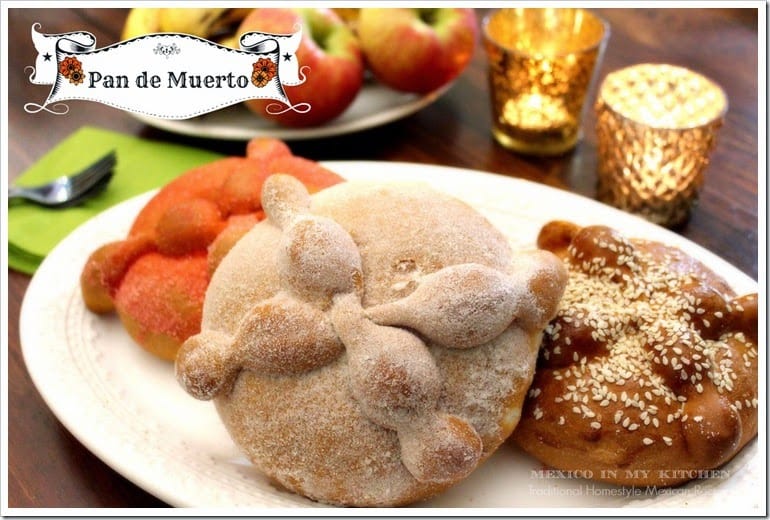
Ecuador: rolls sweet rolls into bread babies. The rolls signify baby dolls and represent deceased people. It is eaten on the Day of the Dead. The bread-like rolls are made with wheat and stuffed with a sweet jelly.

(picture of Ecuador’s baby bread)

Spain creates a soft marzipan tube. It is shaped like a bone and filled with fruit and nuts. Examples include coconut, kiwi, chestnut, and strawberry. It is dipped into a syrup.

(shown to the right is a Spanish/Mexican Day of the Dead bread)

Halloween evolved from the Celtic festivals observing the dead. Countries have different specialties for observance. Perhaps research treats from other countries. Make one and offer it to your family for the Halloween Holiday. (I’m thinking pumpkin bread or apple bread?)

Candy for the Halloween. Is there a healthy candy?

Drum roll: The Number One Favorite Candy for Halloween:

Reese’s Peanut Butter Cups!

Oddly also one of the healthiest candy!

Peanut M&M comes in second and is also considered a healthy candy. In a poll most of the 50 states chose either Reese’s Peanut Butter Cups or Peanut M&Ms. (I prefer Peanut M&Ms.)

Kansas you like Candy Corn! (just a couple pieces, please!) And Georgia likes Nerds. Connecticut likes Sour Patch Kids! Interesting and fun!4

The Best candy to offer for all ages: 5

The Best candy to offer is Hershey’s Mini Chocolate Bars. Three pieces equal 190 calories. They contain 3 g of protein and 21 g of sugar! It is easy to eat and melts in the mouth (without nuts or “krackles”)

The very worst? It is Nerds with 42 g of sugar. (4 grams of sugar in 1 tsp = 10.5 Teaspoons of sugar in one little bag!!!) Only 180 calories, and no proteins. Smarties is close to last also with 36 grams of sugar! (Only 9 teaspoons of sugar in one roll!) I think I read that Candy Corn is right there next to Nerds.

Reese’s Peanut Butter Cups: 5 pieces: 23 grams of sugar (5.25 teaspoons sugar) not soo good but has protein and fiber: 220 calories, 1 g fiber!, 4 g protein, 4% calcium, and 6% iron! But also 13 grams of fat. (So good and not so good. But what did you expect: it’s candy! I guess I never thought of protein and candy together!) Interesting!

Be careful how much candy kiddos eat before bedtime or school!

Remember sugar is a stimulant. A lot of sugar turns a child into a restless imp!

Or you can give out: Mini Pretzels. 3 grams of fat, 132 calories in 32 sticks, but 330 grams of sodium, less than 1 gram of sugar, 0 protein. Lots of carbs, very little sugar, with a whole lot of sodium for a small treat.

Is it possible for Halloween to be a healthy holiday?

There are ways to make Halloween healthy.

First choose a fruit before the candy. Eating an apple will diminish how much empty sugar calories you eat. Then enjoy the candy sweet.

Combine the pretzels with cheese and an apple. I’d sneak in carrots or celery too!

An apple is always good. Apples are relatively high in sugar, but they’re still a good choice. A large apple has about 25 grams of sugar. This amount is significantly higher than the sugar content of a banana or orange, for example. But!

The advantage the apple has over candy: Apples contain fiber, vitamin C, and antioxidants. A medium-sized apple provides the following: 11–14% of a person’s daily fiber needs. 10% of a person’s daily vitamin C needs. And is plenty sweet!

You can also think of donating the candy to a charity. My town has a dentist that takes in candy and ships it overseas. (Yes, it still is a lot of sugar calories, but children overseas don’t usually get a whole 5 pounds of candy to eat. Its fun to share. Sometimes this dentist ships candy to armed forces overseas for a treat, or to share.)

What is the safest Halloween Treat? Safest meaning easy for a small child to eat.

If you kiddos are very small, definitely check their bags for candy that they won’t choke on. You can make a game out of it: decide which candy to eat each day. Maybe lay it out in plastic bags. I’m betting in a week, the interest will disappear. And so can the candy.

The safest option of trick or treat candy is individually wrapped treat, without nuts or common allergens.

The of choice for easy to eat is miniature chocolate bars. You want something that does not cause choking. Yogurt covered raisins can be another alternative; altho raisins have fallen out of favor.

If you want safe: choose something that melts in the mouth. Small pieces or bite-off piece is better than something hard or chewy when it comes to little people.

Be careful of sticky candy that sticks to the teeth.

Sticky candy is a challenge for your teeth. So is extra hard or large candy. Bit-O-Honey falls into the category of sticking to your teeth. So does taffy, and even Tootsie Rolls.

Hot candies are not a good choice: Hot Tamales, Atomic fireballs. Peeps are not favored either, nor is candy corn. Little people don’t do hot candies.

Do you check your trick or treaters bag?

55% of parents check the kiddos’ candy for harmful materials. Look for small rings in bags for little people. Look for something that little people shouldn’t put in their mouths. Also check for the candy that sticks to their teeth.

40% of adults admit to removing candy from the child’s trick or treat bag. 21% admit to throwing the entire haul of candy out after a few weeks!

I won’t tell you the percentage that gives out old candy. (What’s old candy?)

(And you thought you were the only one who checked the treat bags?)

Please be careful as to how much candy the child eats before bedtime. I always made sure that my kiddos had something to eat before trick or treat. Many times “sloppy joes” were offered to the whole group of kids! It became an impromptu party! Food before “trick or treat” means candy does not become supper.

And please, no candy before school or at school lunches. Your child’s teacher will thank you.

Best advice for Trick or Treaters: (and their parents)

How to Trick or Treat Safely (recommended by American Family Insurance)

  • Walk — don’t run — from house to house using sidewalks when possible.
  • Carry a flashlight so you can safely see where you are walking
  • Be aware of and avoid open flames like candles in jack-o’-lanterns.
  • Avoid homemade treats and only eat factory-wrapped candy.
  • Remove your child’s or teen’s makeup soon after trick-or-treating to avoid skin irritation. A face washing after is always good.

I’ll add that parents walking with kiddos can be fun for all. (I so look forward to talking with neighbors on that night. Everyone’s door is open and the lights are on! My whole street feels so warm!)

Halloween is a fun night of traditions. It is fun to be someone else for a night, especially for little people. Take time to enjoy.

I like Halloween for the porch lights and the costumes. It is a special night for all participants.

Don’t just give out the treats, take the time to interact with your door-ringers and even their chaperons! I’ve given out treats for the chaperons too! It will give you joy to see their reactions. And it’s fun to talk to the neighbors on that dark, but warm-lit night.

As you child ages, perhaps share some of the history of the night. Use pumpkin in your meals.

Buy safe treats. Maybe omit cheap heavy sugared candies.

Encourage a good meal before a candy treat. (And yes, I won’t tell if you throw a lot of the Halloween candy out. I think the fun is walking that night and seeing all the costumes and the open doors with smiling faces!)

There are ways to make the Halloween “haul” healthy. Watch how much your kiddo eats and when. Candy is meant to be a treat after a meal. Candy is not an in-between snack.

By rationing it out, you are also teaching children that sweets are special and not usual.

You are also teaching them it is after a meal to enjoy. Candy is not meant to be eaten by the bowl in front of the TV. All of these action do help in creating good eating habits for your children in the future.

Maybe create a new food tradition or a fun Halloween night meal. Offer chili or sloppy joes before trick or treating. Incorporate pumpkin into your meal. There are many recipes: from soups to breads. Pumpkin soup is a real delight in the Fall. You can roast slices like a sweet potato to eat at your meal.

Cook with pumpkin and include them in your meal plans. This shows your kiddos that Fall offers more than just candy.

Have fun this Halloween! I hope the weather is good!

And don’t forget to brush your teeth!

https://wellness.maryjessen.com

References:

  1. https://www.investopedia.com/financial-edge/1012/how-much-americans-spend-on-halloween.aspxt ↩︎
  2. https://www.worldhistory.org/article/1456/history-of-halloween/ ↩︎
  3. https://www.chefsdeal.com/blog/traditional-halloween-foods ↩︎
  4. https://www.realsimple.com/most-popular-halloween-candy ↩︎
  5. https://www.bigcitymoms.com/parenting-articles/what-are-the-healthiest-halloween-candies-theyre-not-what-you-think/ ↩︎

https://www.history.com/news/halloween-trick-or-treating-origins